MJF 3D Printing for Production-Grade Components
Produce dense, detailed nylon components with the repeatability needed for functional assemblies, mechanical housings, and low-volume production. PartsMake helps you move from CAD to reliable end-use parts without the cost of injection molding tooling.
±0.2 mm
Typical accuracy
0.08 mm
Layer thickness
1–5
Working day lead time
1,000+
Units supported
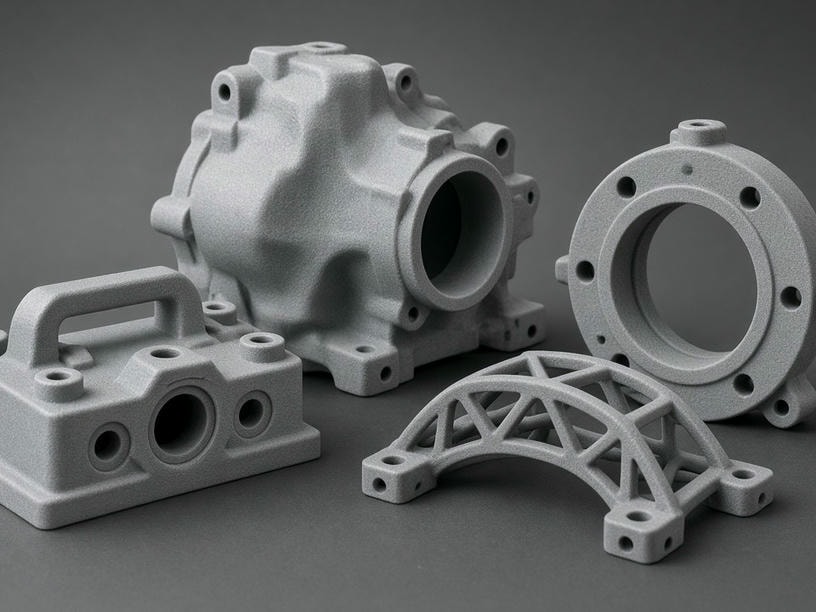
Built for repeatability
Stable batch output, isotropic performance, and practical finishing options for parts that go into the field.
Why MJF
A dependable bridge from prototype to production
Multi Jet Fusion combines high throughput with dense, fine-detail nylon parts. It is particularly effective when you need functional performance, consistent batches, and low-volume quantities before committing to injection molding.
Consistent batches
Stable process control supports repeatable output from a single prototype through 1,000+ production units.
Functional detail
Fine features, thin walls, snap-fits, and complex geometries can be produced without traditional tooling.
Mechanical confidence
High-density parts provide excellent strength uniformity across XYZ directions for demanding end-use applications.
Technology comparison
MJF vs. SLS for production decisions
Both powder-bed technologies support complex geometry. The differences below help identify the right process for your performance, appearance, and quantity requirements.
| Feature | MJF | SLS |
|---|---|---|
| Production speed | High, layer-based fusing | Moderate, point-by-point laser |
| Dimensional accuracy | High, ±0.2 mm typical | Moderate, ±0.3 mm typical |
| Surface finish | Fine and uniform | Slightly granular |
| XYZ strength | Excellent isotropic properties | Good, with slightly lower Z strength |
| Material base color | Grey, ideal for dyeing | White, natural finish |
| Typical application | Production and functional end-use | Complex geometries and prototyping |
Technical capabilities
Production parameters you can plan around
Our MJF setup is configured to bridge early concept models and production-ready parts while maintaining batch consistency across changing quantities.
Engineering review
Every file is reviewed for manufacturability before printing so potential design issues can be addressed before production.
Max build size
380 × 284 × 380 mm
Typical tolerance
±0.2% (min ±0.2 mm)
Material performance
Choose the material around the job
Select a performance profile based on stiffness, impact resistance, flexibility, and the environment your component will experience.
Material selection note
PA12 is a strong starting point for most functional components where dimensional stability and a balanced mechanical profile are required.
Structural integrity
Designed for strength in every direction
MJF parts achieve high density and a high degree of mechanical isotropy. Compared with processes that can be weaker along layer lines, this supports dependable functional loading through the part.
- ●Ducting and manifolds: pressure-tight, complex internal geometries.
- ●Mechanical enclosures: high-detail, thin-walled designs requiring rigidity.
- ●Jigs and fixtures: durable, repeatable tools for factory floors.
- ●Snap-fit assemblies: precise tolerances for repeated engagement.
Production-grade part profile
XYZ
Uniform mechanical performance across build directions
Fine detail
Feature capability from 0.3–0.5 mm
Low-volume ready
A practical route to functional parts before tooling
Finishing options
Turn a printed part into a finished component
Choose secondary operations around appearance, wear, sealing, and interface requirements.
Dyeing
Standard black dyeing creates a consistent deep-colored surface that resists scratching and wear better than paint.
Vapor smoothing
Seals the surface and reduces porosity for improved cosmetics, chemical resistance, and components requiring hermetic seals.
Bead blasting
Removes excess powder and provides a uniform matte finish across the part.
CNC secondary machining
Adds tighter-tolerance holes, threads, or mating surfaces where the printed interface needs further refinement.
From CAD to production
A clear path to your next production-grade part
Share your files
Upload STEP or STL files and include your required quantity.
Define the finish
Specify material and options such as vapor smoothing or black dyeing.
Review the quote
Receive a technical review and production quote within 24 hours.
Ready to start?
Build a better low-volume production plan
For complex assemblies or larger production quantities, our engineering team can discuss your requirements directly.
Request a Technical QuoteStart your project
Tell us what you need to make
Share your CAD files, material preference, quantity, and finishing requirements. PartsMake will review your project for MJF manufacturability.
Email:
Address: