Controlled surface finishing for production parts
Precision Bead Blasting Services
PartsMake provides industrial bead blasting services for engineers and product teams requiring uniform surface finishes, reliable cosmetic consistency, and production-ready results.
Controlled glass bead media helps remove surface defects, hide machining marks, and prepare components for secondary processes such as anodizing or powder coating.
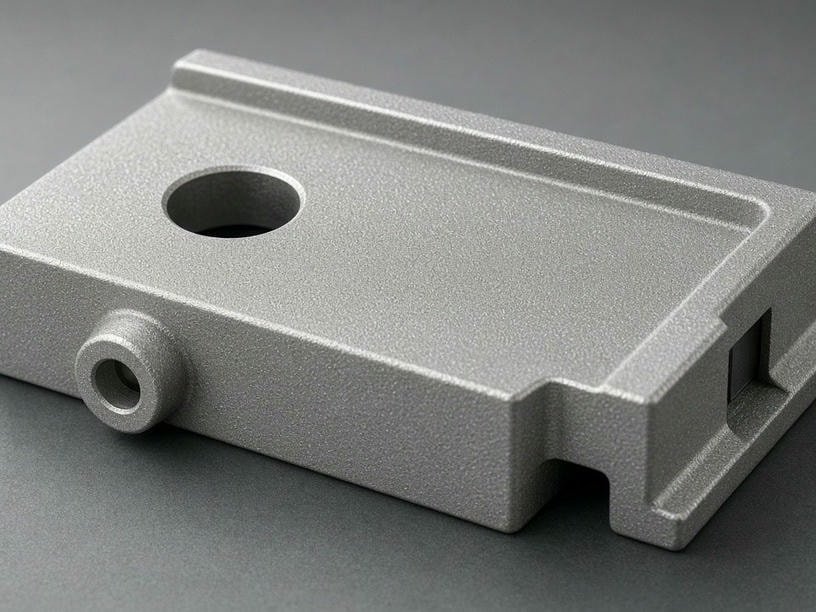
Finish control
Uniform, non-directional matte
Production focus
Prototype to high volume
Surface engineering
Achieving a uniform matte finish
Bead blasting is a mechanical surface treatment that uses spherical media, typically glass beads, to impact the surface of a part. The controlled impact creates a uniform, non-directional matte finish across the entire geometry.
Unlike manual sanding or chemical etching, bead blasting provides precise control over the final texture. By selecting the correct air pressure and media size, we reduce the glossy and inconsistent appearance often left by CNC machining.
The result is a professional surface suitable for consumer electronics, medical devices, aerospace components, and other applications where cosmetic consistency matters.
Texture control
Media selection matched to your finish target
Final appearance depends on the media size, air pressure, part geometry, and starting surface condition. Our engineering team selects the appropriate media to achieve the required roughness and visual finish.
Smooth satin-like matte
Ideal for tight-tolerance parts where minimal material removal is required.
Balanced uniform texture
The standard choice for many aluminum enclosures and housings.
Deeper industrial matte
Used for larger components or when a distinct, more aggressive texture is required.
Cosmetic consistency
Hide machining marks and control the final appearance
CNC milling and turning can leave micro-scratches or visible patterns even after standard deburring. Bead blasting acts as a mechanical masking process: bead impact creates a microscopic dimpled surface that diffuses light and conceals machining marks.
This is especially valuable for raw metallic parts and components receiving clear-coat anodizing, where a consistent cosmetic appearance is essential.
Production assurance
A repeatable finish from first article to production
-
1
Media management
Media breakdown is monitored and glass beads are cycled regularly to maintain a consistent blast pattern.
-
2
Parameter locking
Pressure, nozzle distance, and dwell time are documented so the 1,000th part matches the 1st.
-
3
Visual standards
Acceptable and unacceptable limit samples are established before full-scale production begins.
Technical reference
Bead blasting parameters
Media selection influences roughness, appearance, and suitability for subsequent finishing. Values below are estimates and depend on base material hardness and initial surface condition.
| Glass bead size | Roughness (Ra) | Typical material | Finish appearance | Anodizing compatibility |
|---|---|---|---|---|
| Fine (120–150 mesh) | 0.8–1.6 µm | Aluminum, steel, brass | Smooth satin / matte | Excellent |
| Medium (80–100 mesh) | 1.6–3.2 µm | Aluminum, stainless steel | Uniform matte | Good |
| Coarse (40–60 mesh) | 3.2–6.3 µm | Castings, heavy plate | Rugged matte | Moderate |
Roughness values are estimates and depend on the base material hardness and initial surface condition.
Engineering guidance
Plan the finish before production
How does bead blasting affect cosmetic parts? +
The process diffuses reflected light through a fine dimpled texture, helping conceal machining marks and making the surface appear more uniform across the component.
Which information should be included in an RFQ? +
Please provide material specifications, the desired finish or Ra value, areas requiring masking, and annual or batch production quantities.
Can bead blasted parts move to anodizing? +
Yes. Compatibility depends on media selection and the material. Fine media is generally excellent for anodizing, while coarse media may provide moderate compatibility.
From prototype to production
Integrate finishing into your manufacturing workflow
PartsMake supports projects from initial prototypes through high-volume production. Integrating surface finishing directly into the workflow reduces logistics time and helps parts arrive ready for final assembly.
Start your RFQRequest a quote
Send your bead blasting requirements
Share your CAD files and technical requirements for an accurate review. STEP and IGES files are supported.
- ✓Material specifications
- ✓Specific surface finish requirements or desired Ra
- ✓Areas requiring masking, such as tapped holes or mating surfaces
- ✓Annual or batch production quantities
Email:
Address: