Powder Coating Services for Custom Metal Parts
PartsMake provides powder coating for CNC machined, turned, fabricated, welded, and assembled metal components. We help engineering teams, OEMs, product developers, and procurement teams achieve durable, consistent finishes for prototypes, pilot builds, and repeat production.
60–120 μm
Typical film thickness
RAL
Color system support
160–200°C
Common curing range
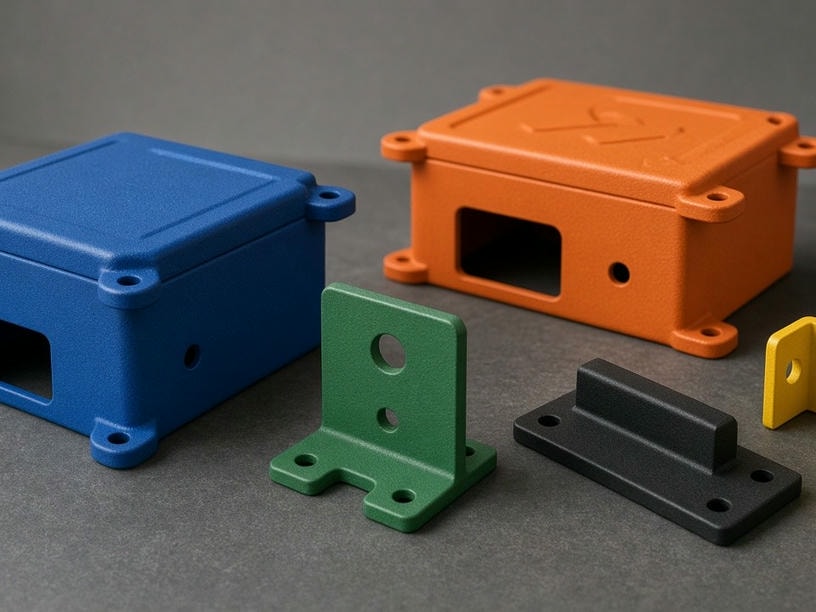
Finish control
Film thickness, gloss, texture, and color
Assembly ready
Masking for threads, fits, and grounding
Functional protection
Wear resistance, corrosion protection, insulation, and surface hardness.
Controlled appearance
RAL colors, matte through gloss finishes, and multiple textures.
Manufacturing continuity
Machining, fabrication, coating, inspection, packaging, and shipping through one supplier.
Built around your part
Powder coating for functional and cosmetic components
Powder coating is a dry finishing process in which electrostatically charged powder is applied to a conductive metal surface and cured under heat. The powder melts and flows into a continuous protective film.
Part applications
- Sheet metal enclosures and panels
- CNC machined housings
- Equipment brackets and frames
- Robot and automation components
- Electrical and electronic housings
Outdoor and industrial
- Outdoor hardware and mounting parts
- EV and energy equipment
- Industrial covers and guards
- Medical and laboratory frames
- Structural components
Powder systems
- Exterior-grade polyester
- Epoxy for indoor protection
- Epoxy-polyester hybrid
- Textured and structured powders
- Matte, satin, and gloss finishes
Integrated services
- CNC milling and turning
- 5-axis machining
- Sheet metal cutting and bending
- Welding and frame fabrication
- Deburring, inserts, and assembly
Technical specification
Define the finish before production begins
Actual performance depends on substrate, pretreatment, powder chemistry, geometry, film thickness, curing, and end-use conditions.
| Item | Typical range or options | Engineering consideration |
|---|---|---|
| Film thickness | 60–120 μm typical | Affects holes, slots, fits, and mating surfaces |
| Curing temperature | 160–200°C, powder dependent | Review temperature-sensitive inserts and assemblies |
| Color system | RAL colors and sample matching | RAL 9005, 9016, 7035, and 7016 are common |
| Gloss and texture | Matte, satin, semi-gloss, gloss, fine, sand, wrinkle | Changes appearance, cleaning, grip, and label adhesion |
| Base materials | Aluminum, carbon steel, stainless, galvanized steel | Pretreatment varies by material and exposure |
| Corrosion resistance | Project-dependent salt spray requirements | Define outdoor, humid, or aggressive environments |
| Inspection | Visual, thickness, color, adhesion, dimensional | Inspection level follows drawing and project risk |
Dimensional control
Coating thickness affects assembly
A typical powder-coated surface adds approximately 60–120 μm per exposed face. On outside dimensions, coating can increase size on both sides; inside holes and slots lose clearance.
Review a Coating-Critical PartPotential impact
A 10.00 mm slot may become smaller, and tight-fitting covers may not assemble after coating.
Protect these areas
Threads, bearing seats, dowel holes, sealing faces, rails, locating bosses, and connector openings.
Keep continuity
Grounding pads and electrical contact areas should remain uncoated where conductivity is required.
Plan early
Drawings should identify coated and uncoated areas to reduce rework and assembly risk.
Appearance engineering
RAL colors, gloss, and texture
RAL colors help maintain consistency across production batches, suppliers, and product lines. When exact color control matters, physical powder samples, approved plaques, or reference parts are recommended before production.
Smooth and matte: clean industrial appearance and easier wipe-down.
Fine and sand texture: helps hide minor scratches and handling marks.
Wrinkle and structured finishes: stronger visual character for covers, guards, and rugged equipment.
Common appearance requirements
Process and durability
Outdoor performance starts with pretreatment
Cleaning, conversion treatment, drying, and surface inspection support adhesion and long-term corrosion protection.
Prepare
Degrease, clean, rinse, condition, and remove weld contamination, oil, oxidation, and burrs.
Pretreat
Select phosphate or conversion treatment according to substrate and exposure conditions.
Coat and cure
Apply the specified powder and cure within the system temperature and time requirements.
Verify
Check appearance, thickness, masked areas, dimensions, adhesion, and corrosion requirements.
Outdoor considerations: UV stability, fading, chalking, salt spray, rain, humidity, temperature cycling, edge corrosion, installation scratches, drainage, and water retention should be considered during RFQ review. Exterior-grade polyester and suitable pretreatment are normally recommended for outdoor parts.
Masking and assembly
Protect functional surfaces before powder is applied
Powder in threaded holes can cause fasteners to seize, cross-thread, or fail to seat. Because powder is generally insulating, grounding points also need defined uncoated areas when electrical continuity is required.
Show masking clearly on the drawing
Use notes, highlighted views, or separate finishing instructions to define:
- •Exact uncoated area size and location tolerance
- •Bare metal or conductive finish requirements
- •Inspection method for electrical continuity
- •Threads, inserts, PEM hardware, and weld nuts
- •Areas that require later bonding, welding, or labeling
Material and part fit
Suitable substrates and manufacturing routes
Powder coating works best on conductive metals that can withstand curing temperatures. Material affects pretreatment, adhesion, corrosion protection, and appearance.
| Material | Project note |
|---|---|
| Aluminum | Very common for housings, brackets, and machined parts |
| Carbon steel | Very common; pretreatment is essential for corrosion resistance |
| Stainless steel | Possible with suitable surface preparation |
| Galvanized steel | Possible with review for outgassing and adhesion |
| Zinc die casting | Review porosity and outgassing risks |
Machined and fabricated part review
CNC machined parts
Review milled pockets, O-ring grooves, mounting datums, connector openings, reamed holes, location bosses, and tight fits. Anodizing may be preferable where dimensional change must be minimal.
Sheet metal fabrication
Account for bend radii, weld cleaning, sharp edges, drainage holes, hanging marks, panel flatness, PEM hardware, fastener installation, and electrical contact areas.
Integrated workflow
Parts can be machined, formed, deburred, cleaned, masked, coated, inspected, assembled, packed, and shipped through one coordinated supplier.
Quality assurance
Inspection matched to use and risk
Inspection planning can be defined before manufacturing begins, with critical dimensions checked before and after coating where buildup may affect assembly.
Appearance
RAL or sample color, gloss, texture, visible surfaces, contamination, orange peel, pinholes, and blistering.
Dimensions
Film thickness, holes, slots, threads, masked area location, critical fits, and assembly interfaces.
Performance
Adhesion, corrosion testing, salt spray requirements, and electrical continuity where specified.
Protection
Packaging review to prevent chips, scratches, masking damage, and handling marks during shipment.
Project support
From prototype to repeat production
Consistent drawings, approved finish requirements, inspection criteria, and packaging standards support each production stage.
Prototype parts
Fit checks, appearance review, design validation, and customer approval.
Engineering samples
Confirm material, thickness, masking, color, gloss, and assembly performance.
Pilot and production
Validate repeatability, inspection, workflow, packaging, and delivery requirements.
Information to include in your RFQ
Engineering guidance
Common powder coating questions
Request a quote
Plan the right finish before production
Send your drawings, CAD files, coating requirements, and quantity to PartsMake. We will review film thickness, RAL color, texture, outdoor exposure, masking, assembly-critical surfaces, and inspection needs before quoting.
Email:
Address:
Share your project details
For faster review, include the RAL color, desired film thickness, texture, gloss level, exposure conditions, threads, grounding points, and uncoated assembly surfaces.