Precision Aluminum CNC Machining and Sheet Metal Fabrication
PartsMake provides high-precision aluminum manufacturing services for automotive, aerospace, robotics, and industrial applications. From single-piece prototypes to large production runs, our team supports engineering and procurement teams with material guidance and production-ready execution.
±0.005 mm
CNC machining tolerance
5-axis
Complex geometry support
3000 × 1500 mm
Maximum laser bed size
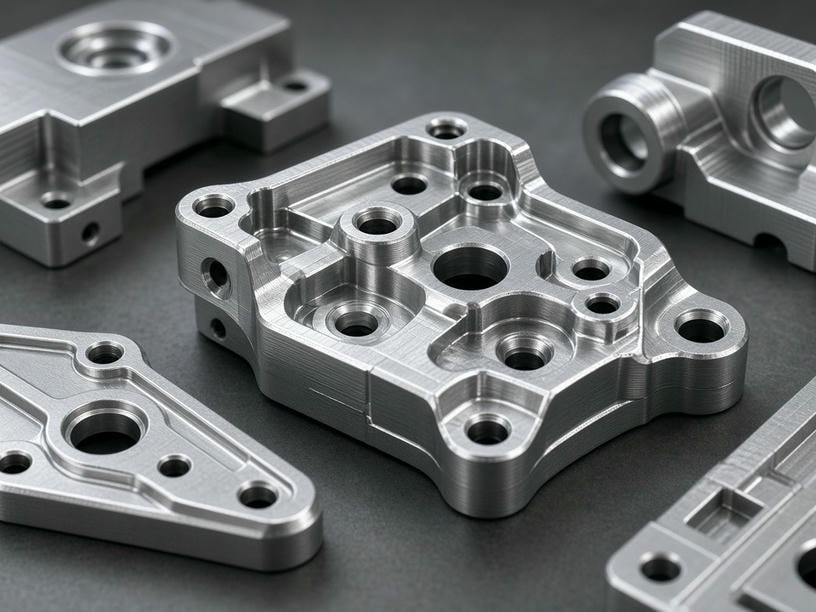
Built for production
Material selection, machining, fabrication, finishing, and inspection coordinated through one manufacturing partner.
Technical properties of common aluminum alloys
Aluminum combines a low density with strong mechanical performance, excellent machinability, and useful corrosion resistance. Compare common grades before selecting the right material for your part, process, and operating environment.
| Alloy | Density (g/cm³) |
Tensile strength (MPa) |
Hardness (Brinell) |
Machinability | Weldability | Corrosion resistance | Typical application |
|---|---|---|---|---|---|---|---|
| 6061-T6 | 2.70 | 310 | 95 | Excellent | Excellent | Good | Structural parts, fittings, brackets |
| 7075-T6 | 2.81 | 570 | 150 | Good | Poor | Moderate | Aerospace and high-stress parts |
| 2024-T3 | 2.78 | 470 | 120 | Good | Poor | Moderate | Aircraft structures |
| 5052-H32 | 2.68 | 230 | 60 | Fair | Excellent | Excellent | Sheet metal and enclosures |
| 6082-T6 | 2.70 | 310 | 95 | Excellent | Excellent | Good | Automotive and structural parts |
| MIC-6 | 2.70 | 170 | 65 | Excellent | Good | Good | Tooling plates and jigs |
Published values are typical reference values and may vary with temper, thickness, and supplier condition. Confirm final requirements with the engineering team.
6061-T6 vs. 7075-T6
The right alloy balances strength, weight, cost, corrosion behavior, weldability, and finishing requirements. These two structural grades are common starting points for design reviews.
6061-T6 — the general-purpose workhorse +
Advantages: Versatile, cost-effective, highly weldable, and easily anodized.
Trade-off: Lower strength than 7000-series alloys.
Best for: Housings, consumer electronics, brackets, and general mechanical components.
7075-T6 — the high-performance alloy +
Advantages: High strength-to-weight ratio and excellent fatigue resistance.
Trade-offs: More expensive, difficult to weld, and requires careful handling to reduce stress-corrosion risk.
Best for: Structural aerospace parts, high-load gears, and precision fixtures.
CNC machining or sheet metal fabrication?
We select the most cost-effective route based on geometry, tolerance, production volume, and structural requirements.
CNC Machining
Complex geometryBest for tight tolerances, complex internal geometry, high structural integrity, and precision mating surfaces.
- 013-, 4-, and 5-axis milling, turning, and mill-turn operations
- 02Tolerance down to ±0.005 mm
- 03Ideal for housings, complex brackets, engine components, and mating surfaces
Sheet Metal Fabrication
Efficient structuresBest for enclosures, panels, chassis, and covers where weight, speed, and cost efficiency are priorities.
- 01Fiber laser cutting, CNC bending, and TIG or MIG welding
- 02Tolerance of ±0.10 mm for cutting and ±0.25 mm for bending
- 03Ideal for electronic enclosures, mounting plates, frames, and covers
Make aluminum perform and present better
Surface treatment can improve wear resistance, appearance, conductivity, and traceability. We coordinate finishing with your material and application requirements.
Anodizing
Type II and Type III anodizing for improved wear resistance and a consistent decorative finish.
Powder coating
A durable, impact-resistant finish for aluminum sheet metal enclosures and structural covers.
Laser marking
Permanent part identification and traceability for assemblies, batches, and service records.
Conversion coating
Chromate conversion coating for electrical conductivity and corrosion protection.
Production capabilities at a glance
CNC machining
- Milling size
- Up to 1200 × 800 × 600 mm
- Turning diameter
- Up to Ø500 mm
- Swiss machining
- Up to Ø32 mm
- Quality control
- CMM, full reports, batch traceability
Sheet metal fabrication
- Laser cutting
- Up to 3000 × 1500 mm; 20 mm aluminum
- Press brake
- Up to 200 tons
- Welding
- TIG, MIG, and laser welding
- Hardware
- PEM nut and stud installation
Turn your aluminum design into a production-ready part
Whether you need a low-volume prototype or high-volume production, our engineering team is ready to review your CAD files and material specifications.
Accepted formatsSTEP, IGES, DXF, and DWG
Engineering contact
Facility location
Recommended detailsDrawings, alloy, finish, quantity, and target timing
Contact our engineering team
Attach your technical drawings and material specifications to receive an accurate lead time and cost estimate.