Precision CNC Machining for Acrylic Components
Produce clear housings, optical covers, light pipes, lenses, and display components with controlled CNC machining tailored to acrylic and PMMA.
Acrylic delivers excellent light transmission and visual appeal, but its brittleness and sensitivity to heat require carefully managed tooling, chip load, feed rates, and finishing processes.
~92%
Typical light transmission
±0.05 mm
Critical machining tolerance
3-axis & 5-axis
CNC machining centers
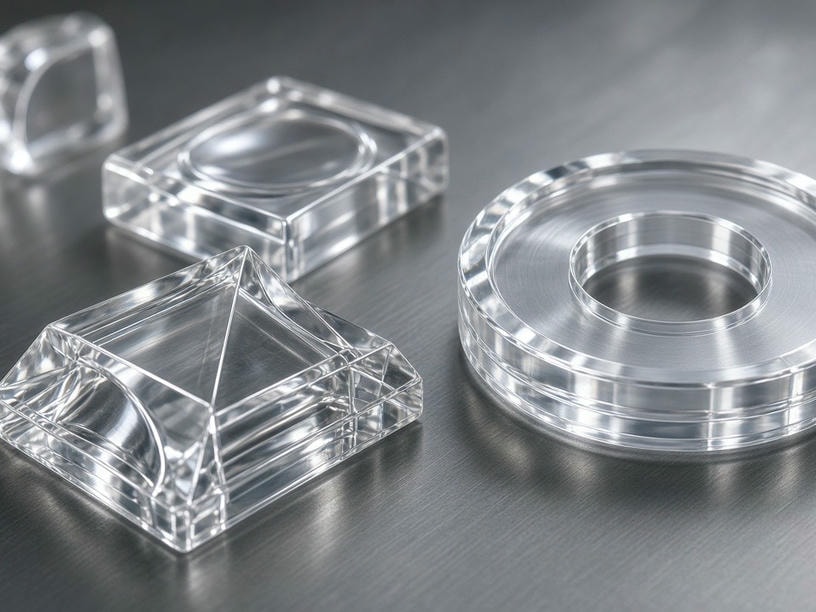
Built for clarity
Process control protects optical performance, dimensional accuracy, and cosmetic quality.
Engineering-grade capability
Acrylic machining that protects the part from design through production
We transform acrylic sheets and blocks into finished components while managing the stress, heat, and surface sensitivity that can cause crazing, melting, chipping, or unwanted haze.
Controlled cutting
Specialized tooling geometry, optimized feed rates, and appropriate chip load reduce heat buildup and edge chipping.
Optical surface control
Machining and secondary finishing are selected to preserve light transmission, clarity, and the required cosmetic standard.
Scalable repeatability
The same process discipline supports functional prototypes and production runs up to 10,000 pieces.
Material data
PMMA specifications that shape the process
Understanding acrylic’s optical, mechanical, and thermal behavior helps determine the right cutting strategy, handling method, and finishing route.
| Property | Typical value | Machining impact |
|---|---|---|
| Light transmission | ~92% | Requires a pristine surface finish to maintain the optical path |
| Hardness, Rockwell M | 70–80 | Prone to scratching; protective handling is required |
| Tensile strength | 70–80 MPa | Brittle material; specialized feed rates help prevent chipping |
| Heat deflection temperature | 95–105°C | Thermal management helps prevent melting and burrs |
| Machining tolerance | ±0.05 mm | Achievable with controlled stress-relief protocols |
| Surface finish | Ra 0.4–1.6 μm | Depends on the selected post-machining polishing technique |
Finishing options
Choose the right route from machined clarity to glass-like finish
Transparent CNC machining establishes the geometry. The finishing method then determines how tool marks, edges, and complex surfaces appear.
Mechanical polishing
Dimensional controlMulti-stage abrasive compounds remove tool marks and are ideal for flat surfaces and simple geometries where high dimensional accuracy matters.
Flame polishing
Fast edge finishA controlled heat pass melts the outer surface to create a smooth, glass-like edge. It suits edges and non-critical dimensions where heat exposure is acceptable.
Vapor polishing
Complex geometryVapor polishing creates a uniform high-gloss finish on complex geometries and internal cavities that mechanical tools cannot reach.
Design-to-production support
Complex acrylic parts without compromising fit or appearance
Our engineers review designs for thin walls, sharp internal corners, stress concentrations, and other risks before production begins. This helps reduce material waste and avoid preventable cracking.
Discuss your part requirements →Complex contours
5-axis machining supports non-planar optical surfaces and complex internal cavities.
Hardware integration
Threaded inserts and standoffs can be installed with torque-controlled processes to prevent cracking around mounting points.
Precision tolerancing
Critical fits can be maintained down to ±0.05 mm for accurate interfaces with metal frames and electronic assemblies.
Production consistency
A controlled process helps the 1,000th production part match the clarity and tolerance of the first.
Project consultation
From transparent prototype to production-ready component
Whether you are developing a medical device prototype or a high-volume cosmetic component for consumer electronics, our team helps optimize the design for manufacturability.
01
Submit STEP, IGS, or DXF files
02
Define finish, transparency, and assembly needs
03
Receive engineering feedback and a formal quote
Request an acrylic machining quote
Send your CAD files and requirements for transparency, surface finish, tolerances, and assembly.
Email:
Address:
Acrylic machining FAQ