Precision CNC Milling
Complex parts, precisely milled.
PartsMake provides high-precision CNC milling for custom metal and plastic components, from single-unit prototypes to high-volume production.
Our 3-axis, 4-axis, and 5-axis machining centers handle tight tolerances, deep cavities, thin walls, precision hole patterns, and complex contours for demanding industrial applications.
±0.005 mm
Precision tolerance
5-axis
Complex multi-face machining
Ra 0.4
Surface roughness capability
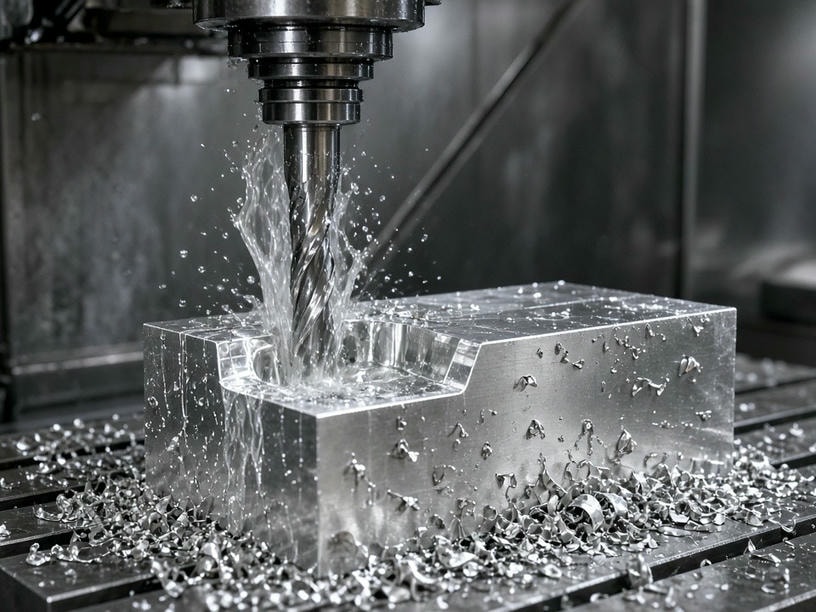
Built for demanding geometry
High-speed machining, complex contouring, and multi-face operations under controlled processes.
Technical capabilities
Milling capacity for real production requirements
Our facility is equipped for high-speed machining, complex contouring, and multi-face operations. Strict process control supports dimensional accuracy and surface integrity from prototype through production.
Discuss your part requirementsMaximum Milling Size
1200 × 800 × 600 mm
Spindle Speed
10,000–20,000 rpm
Axis Configuration
3, 4, and 5-axis
Batch Size
Prototype to high volume
Standard Tolerance
±0.01–0.05 mm
Precision Tolerance
Down to ±0.005 mm
Surface Roughness
Ra 0.4–3.2 μm
Minimum Feature
0.5 mm
Minimum Wall Thickness
0.5 mm
Choose the right process
3-axis vs 4-axis vs 5-axis milling
The right axis configuration balances production speed, part complexity, setup count, and unit cost.
3-axis milling
Best for prismatic parts, housings, plates, and brackets that can be machined from a single orientation or with simple indexing.
- ✓Simple setups and fast throughput
- ✓Ideal for accessible pockets and faces
4-axis milling
Adds a rotary axis for shafts, bushings, and radial patterns. Multiple sides can be reached without repeated manual fixture changes.
- ✓Fewer manual setups
- ✓Efficient radial and indexed features
5-axis milling
Simultaneous 5-axis machining produces organic surfaces and multi-face parts in a single setup, reducing lead time and cumulative fixture error.
- ✓Deep access and angled surfaces
- ✓Lower risk of setup-to-setup variation
Part geometry
Designed for difficult milling features
From deep pockets to fine hole patterns, our process planning matches tooling, workholding, and axis motion to the geometry of your part.
Deep cavities
High-speed milling with long-reach tooling for deep pocket and cavity features.
Thin walls
Vibration-dampening techniques support walls down to 0.5 mm.
Complex profiles
Precision 3D surfacing and contouring for aerospace and medical components.
Hole patterns
Precision hole patterns with positional accuracy down to Ø0.01 mm.
Materials expertise
Materials selected for performance
We work with engineering metals and plastics to match strength, corrosion resistance, wear, weight, and application requirements.
Aluminum
6061-T6, 7075-T6, MIC-6
Stainless Steel
303, 304, 316L, 17-4PH
Steel & Alloys
1018, 4140, D2, H13
Titanium
Grade 2, Grade 5
Engineering Plastics
PEEK, POM, PTFE, Nylon, PC
DFM guidance
Reduce milling cost before production
Standardize hole sizes+
Use standard drill and reamer sizes to avoid custom tooling costs.
Use practical internal radii+
Radiused internal corners allow larger, more rigid end mills than sharp 90-degree corners.
Limit depth-to-width ratios+
Deep, narrow slots increase cycle time and tool-breakage risk. Maintain reasonable ratios for pocketing.
Specify tight tolerances selectively+
Only require tight tolerances where necessary. Over-tolerancing increases inspection time and scrap risk.
Quality assurance
Inspection that supports production confidence
Every production run is backed by rigorous inspection protocols and documented process control.
CMM verification
Full dimensional verification for critical part features.
Optical measurement
Inspection support for intricate and difficult-to-reach features.
Calibrated tools
Height gauges, micrometers, and bore gauges.
Traceability
Batch traceability and material certifications available on request.
Start your project
Request a CNC milling quote
Upload your 3D CAD files in STEP, IGS, or Parasolid format together with 2D drawings to receive a formal quotation. Our engineering team can also discuss material, tolerance, axis configuration, and cost targets.
Email:
Address:
Engineering inquiry