Industrial SLA 3D Printing
High-precision prototypes with a smooth, production-ready finish.
PartsMake produces complex SLA parts for product designers, engineers, and procurement teams. Validate form, fit, appearance, and assembly with accurate parts delivered in as little as 1–5 working days.
±0.1–0.2 mm
Typical precision tolerance
1–5 days
Typical working lead time
1–10,000+
Prototype to batch quantities
Finish
Smooth surfaces
Detail
Fine features
Materials
Clear to tough
Why SLA
Precision where visual fidelity matters.
SLA uses a laser to cure liquid photopolymer resin layer by layer. The process produces fine details, smooth surfaces, and consistent dimensional fidelity for complex geometries that are difficult to machine or mold.
Our industrial SLA systems support everything from one-off concept models to low-volume production. Parts can be finished, painted, polished, machined, or prepared with inserts to match the needs of engineering and presentation teams.
Technical specifications
Built for professional engineering review.
Select layer height, resin, orientation, and finishing requirements around the purpose of your part. Our engineering team can confirm feasibility from your CAD files.
| Specification | Typical PartsMake capability | Engineering note |
|---|---|---|
| Layer thickness | 0.016–0.30 mm | Fine layers support detailed surfaces and visible features. |
| Dimensional accuracy | ±0.1–0.2 mm | Final tolerance depends on geometry, size, orientation, and resin. |
| Minimum wall thickness | 0.5 mm recommended minimum | Thicker walls may be required for large or load-bearing parts. |
| Minimum hole diameter | Typically 0.5–1.0 mm | Confirm with engineering for deep holes, fine channels, or tight fits. |
| Maximum build size | 800 × 800 × 550 mm | Large parts may be segmented and assembled where appropriate. |
| Resin types | Standard, clear, tough, high-temperature | Material selection is matched to appearance, stress, and heat needs. |
| Typical lead time | 1–5 working days | Timing varies with quantity, finish, material, and inspection scope. |
| Production quantity | 1–10,000+ pieces | Suitable for prototypes, pilot runs, and low-volume batches. |
High-detail geometry
Reproduce organic forms, internal channels, fine text, and intricate assemblies with minimal post-processing.
Smooth presentation surfaces
Multi-stage sanding, polishing, bead blasting, painting, and dyeing help parts move from engineering review to customer-facing presentation.
Assembly-ready options
Add threaded inserts, tapped holes, or CNC secondary machining where critical interfaces require additional strength or accuracy.
Resin selection
Choose the material around the test.
Resin choice affects clarity, impact resistance, thermal stability, and long-term performance. Share the intended use and our team can recommend a suitable option.
Standard resin
General-purpose prototypes, concept models, and display parts where appearance is the priority.
Clear resin
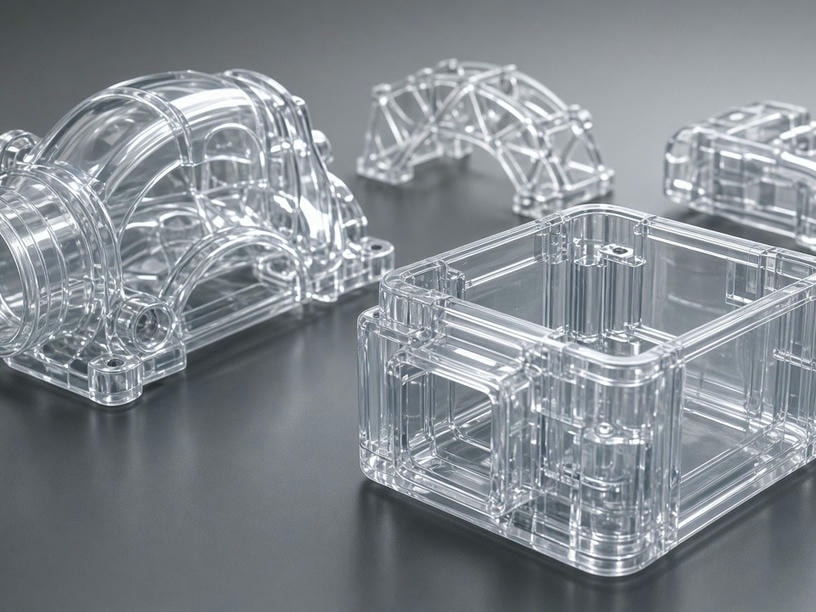
Polished for improved optical clarity in flow visualization, lighting enclosures, lens testing, and transparent demonstrations.
Tough resin
Higher impact resistance for functional prototypes, snap-fits, and parts exposed to moderate stress.
High-temperature resin
Designed for applications that require improved thermal stability and reduced deformation at elevated temperatures.
Finishing workflow
From printed output to presentation-ready part.
Support removal
Supports are positioned strategically and removed carefully to reduce visible scarring.
Sanding and polishing
Progressive sanding and buffing create a refined finish, including specialized polishing for clear resin parts.
Surface treatment
Bead blasting, painting, and dyeing provide consistent textures and custom color presentation.
Engineering finishing
CNC machining, tapping, and threaded inserts support critical interfaces and robust assembly.
Important design considerations
- Resin brittleness: Many SLA materials are more brittle than nylon or other thermoplastics and are not recommended for high-impact loading.
- Support contact marks: Supports are necessary for overhangs. Minor marks at contact points are a technical reality, but placement is planned away from visible faces where possible.
- Wall thickness: A 0.5 mm minimum is recommended as a starting point to protect structural integrity during cleaning and curing.
- Drainage: Hollow parts need drainage holes so uncured resin can escape from internal cavities.
Applications
When SLA is the right choice.
Aesthetic models
High-resolution models for trade shows, investor presentations, and marketing reviews.
Transparent parts
Clear prototypes for lenses, fluidic devices, light pipes, and flow visualization.
Complex assemblies
Intricate channels and organic forms that are difficult to machine.
Master patterns
Accurate masters for RTV silicone molding or vacuum casting.
Form and fit
Assembly validation before investing in hard tooling.
Technical guidance
Common SLA questions.
Request a quote
Send your CAD files to the SLA team.
Share your 3D files and project requirements for a rapid production estimate. For complex parts, include details about transparent polishing, painting, threaded inserts, critical tolerances, and assembly use.
Email:
Office address: