Precision Swiss Machining Services for Complex Small Parts
PartsMake provides high-volume, precision Swiss machining for small-diameter components requiring extreme accuracy. Sliding headstock technology and guide bushing support help maintain strict tolerances on long, thin parts that standard CNC lathes cannot process.
Ø32 mm
Maximum bar diameter
±0.005 mm
Precision tolerance
0.5 mm
Minimum machined feature
100,000+
Pieces per production run
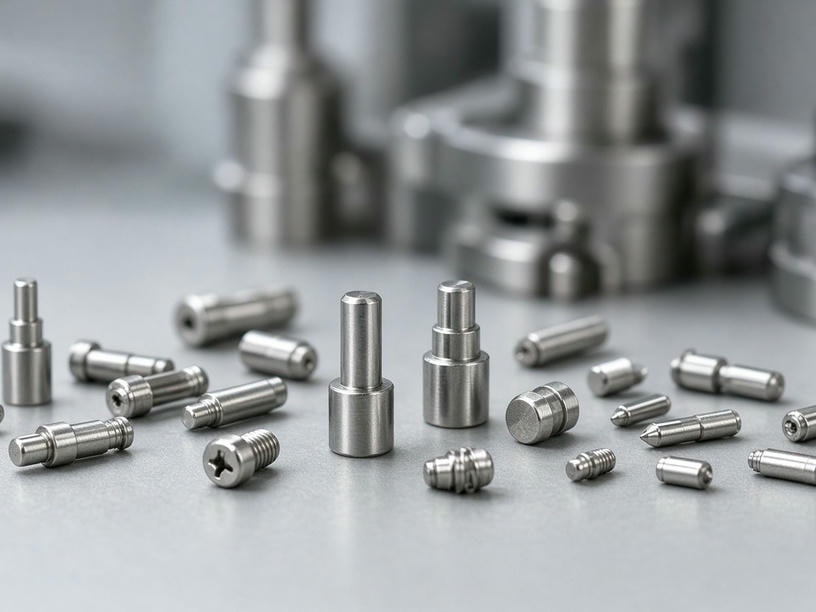
Built for slender, intricate parts
From prototype development to production runs, our process is designed for connectors, medical components, electronics, instrumentation, automotive parts, and other critical applications.
Swiss-type process
Advanced Swiss machining capabilities
Swiss-type CNC lathes support the material immediately beside the cutting tool with a guide bushing. This reduces deflection and helps control diameter on long, slender pins, shafts, and other high length-to-diameter ratio parts.
Discuss your part requirementsGuide bushing support
Continuous support close to the cutting zone helps control deflection, diameter variation, and deformation on slender parts.
Multiple operations, one cycle
Turning, drilling, cross-milling, and threading can be combined in a single cycle to reduce secondary operations and lead times.
Continuous bar production
Automated bar feeding supports repeatable, high-volume production with fewer interruptions and stable part-to-part consistency.
Long-part deformation control
The sliding headstock and guide bushing configuration is suited to small-diameter parts where conventional turning may create deflection challenges.
Production envelope
Technical specifications for Swiss parts
A practical starting point for evaluating fit, tolerance, material, and production volume.
Procurement perspective
How small-part cost declines as volume increases
For intricate, high-volume components, the right production method can reduce the unit-cost burden of setup, handling, material, and labor. Swiss machining is particularly effective when the same operation can be repeated continuously from bar stock.
Prototype and low-volume validation
Early parts confirm geometry, material selection, tolerances, and inspection requirements before production is scaled.
Repeatable batch production
One-cycle machining reduces secondary fixturing and handling, helping distribute setup effort across more parts.
High-volume and lights-out production
Automated bar feeders support continuous operation, reducing labor per piece and improving price stability for larger procurement schedules.
Four cost levers behind the savings
Reduced cycle time: simultaneous turning, drilling, and milling.
Less material waste: efficient bar feeding reduces remnant material.
Lights-out production: automated feeding lowers labor costs.
No secondary fixturing: one setup reduces handling and error risk.
Application fit
Precision control for critical industries
Small dimensions can have a large impact on assembly, reliability, signal integrity, and product performance.
Connectors
Pins, sockets, and housings requiring accurate perpendicularity and concentricity.
Medical & Dental
Surgical instruments, bone screws, and dental implants in titanium and 316L stainless.
Electronics
Miniature components where exact dimensions support reliable electrical connections.
Instrumentation
Small shafts, bushings, and precision components for demanding instruments.
Automotive
High-wear shafts, fasteners, and parts with strict GD&T requirements.
Quality assurance
Proof built into every production run
Our quality process is structured for precision and the documentation needs of high-volume programs.
01
First Article Inspection
Every production run begins with a full dimensional report against the print.
02
Automated inspection
Optical measurement systems and CMM inspection verify micro-features and thread profiles.
03
Batch traceability
Material certification and process documentation are provided for every batch.
Common questions
Make a confident sourcing decision
When is Swiss machining a better choice than standard CNC turning? +
It is especially useful for small-diameter parts with high length-to-diameter ratios, tight tolerances, and multiple operations. Guide bushing support helps reduce deflection on long, slender components.
Which files and information are needed for a quote? +
Submit technical drawings in STEP, IGES, or PDF format together with expected annual volume, material requirements, and any required delivery date.
Can production include material and process documentation? +
Yes. First Article Inspection, material certification, and process documentation support batch traceability and industry-specific quality requirements.
Request a quote
Turn your drawing into a production-ready plan
Submit your technical drawings and project requirements. Our engineering team reviews each file for DFM opportunities that may reduce cost or improve part performance.
Recommended files: STEP, IGES, or PDF
Include: annual volume, material, tolerances, and required delivery date
Standard RFQ response: within 24–48 hours
Email:
Facility:
Send your project requirements
Share your part details and our team will help evaluate the right Swiss machining path.