Engineering-grade plastic manufacturing
Custom Polycarbonate (PC) Injection Molding Services
From DFM and mold design to mass production, finishing, and assembly, PartsMake delivers dependable PC components for demanding applications.
100–1M+
Units supported
50–800T
Machine range
±0.03 mm
Precision capability
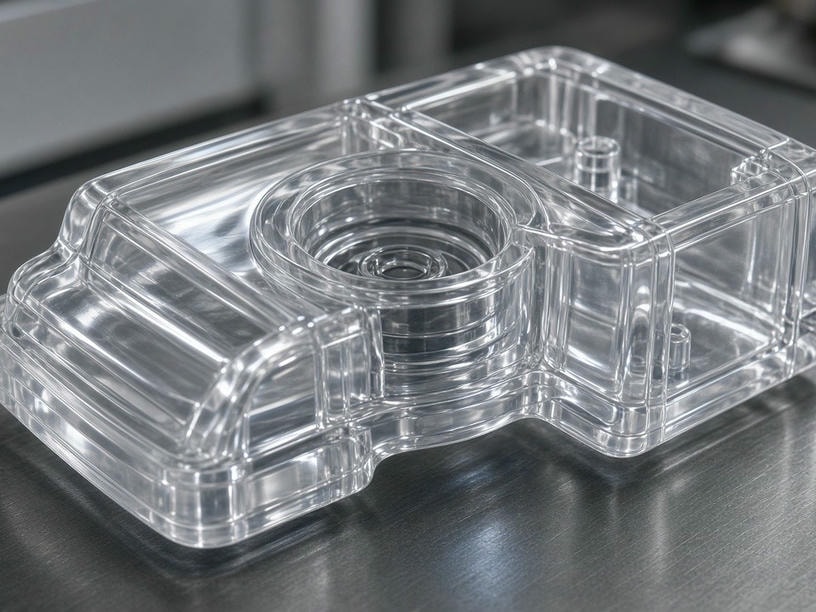
PC process focus
Optical clarity, impact strength, and controlled internal stress
Material intelligence
Technical expertise for a demanding engineering polymer
Polycarbonate combines high impact resistance with optical clarity, making it a strong choice for transparent, protective, and structural components. Its high viscosity, moisture sensitivity, and thermal behavior require disciplined process control.
High viscosity
PC requires higher injection pressures than standard resins, with gate and fill strategy designed around its flow behavior.
Moisture management
PC absorbs moisture rapidly. Proper drying is essential to reduce hydrolysis, brittleness, and surface defects.
Internal stress control
Cooling, gate placement, holding pressure, and mold temperature must be coordinated to reduce brittleness and premature cracking.
Process window
Technical processing parameters
| Specification | Target range |
|---|---|
| Drying temperature | 110°C–120°C, 4–6 hours |
| Melt temperature | 260°C–310°C |
| Mold temperature | 80°C–120°C |
| Shrinkage rate | 0.5%–0.7% |
| Recommended wall thickness | 1.5 mm–3.0 mm |
| Draft angle | 1°–2° |
Transparent component control
Protecting optical quality from fill to final inspection
Clear PC components demand more than a good-looking first shot. Our process addresses flow marks, stress cracking, and long-term dimensional stability as connected engineering risks.
Uniform melt-front advancement
Gate location and injection speed profiles are optimized to reduce visible flow lines across clear sections and cosmetic surfaces.
Lower residual molecular orientation
Precise mold temperatures and optimized holding pressure help minimize internal stress that can cause premature cracking.
Post-molding stress relief
Annealing is available for parts requiring increased dimensional stability and chemical resistance after molding.
Built for production
A complete manufacturing path beyond the press
Our capabilities support parts from under 1 gram to 5 kilograms, with tooling, precision, finishing, and assembly coordinated through one manufacturing partner.
50–800T
Injection molding
Machine capacity for prototypes, complex components, and production programs.
5 steel types
In-house mold making
P20, 718H, NAK80, S136, and H13 for prototype, bridge, and production molds.
±0.05–0.20
Typical tolerance
Precision capabilities down to ±0.03 mm for suitable designs and processes.
SPI A1–D3
Surface and integration
VDI textures, custom patterns, insert molding, overmolding, and threaded inserts.
DFM and engineering support
Every project begins with a CAD review covering wall thickness uniformity, draft angles, ribs, bosses, sink marks, and air traps. Early issue identification helps reduce lead times and optimize cost per part.
Secondary finishing and assembly
Receive integration-ready components with painting, laser marking, printing, mechanical assembly, sonic welding, dimensional inspection, and cosmetic validation to your specified AQL standards.
Tooling strategy
Choose the right mold for your production stage
We match tooling investment and expected lifecycle to your validation, launch, and volume requirements.
Prototype molds
100–1,000 unitsIdeal for iterative design testing, fit checks, and early functional validation.
Bridge molds
Ramp-up supportA balanced option for market testing, initial production, and demand confirmation.
Production molds
100,000–1,000,000+ cyclesHardened steel tooling designed for stable, repeatable high-volume manufacturing.
Engineering questions
Practical guidance for your PC project
Start your project
Request a PC molding quote
Submit your CAD files in STEP, IGS, or X_T format together with material specifications and estimated annual volume. Our engineering team will prepare a DFM analysis and formal quotation based on your production requirements.
Project inquiry
Share your requirements with our team to begin a technical review.
Email:
Facility address: