Precision PTFE CNC Machining Services
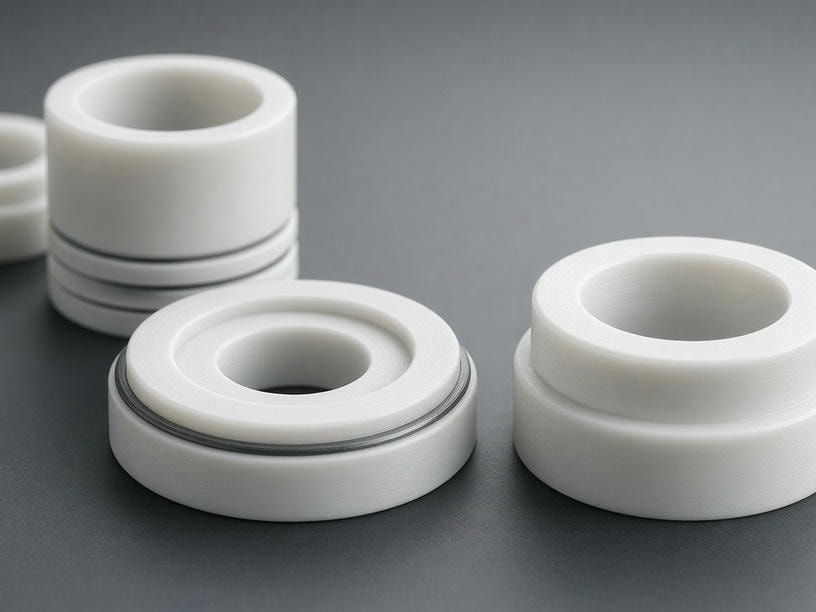
PartsMake specializes in precision CNC machining of PTFE components for procurement teams and design engineers requiring dependable performance in industrial, chemical, and electrical applications.
From one-off prototypes to repeat production runs, we manage PTFE's low friction, chemical resistance, thermal expansion, and material softness to help deliver accurate, functional parts.
0.05–0.10
Typical coefficient of friction
-200 to 260°C
Typical operating range
PTFE performance comes with machining variables
PTFE is valued for exceptional chemical inertness, high-temperature resistance, electrical insulation, and extremely low friction. Its softness and memory effect, however, demand process control beyond standard rigid-plastic machining.
Best suited for
Seals, insulators, sliding components, and chemically exposed parts.
| Property | Typical value or characteristic |
|---|---|
| Coefficient of friction | Extremely low: 0.05–0.10 |
| Operating temperature | -200°C to +260°C |
| Hardness | Shore D 50–65 |
| Tensile strength | 20–30 MPa |
| Water absorption | <0.01%, negligible |
| Chemical resistance | Excellent; nearly universal chemical inertness |
| Dielectric strength | High; excellent electrical insulation |
Designed around PTFE machining challenges
Our workholding, tooling, cutting, and inspection methods address the material behaviors that can cause dimensional drift or assembly problems.
Thermal expansion
Temperature-controlled environments and suitable coolant strategies help prevent dimensional drift during machining and stabilization.
Dimensional recovery
Specialized tool geometries and calculated tool-path offsets account for PTFE's memory effect and spring-back after cutting.
Soft-material workholding
Custom soft jaws and low-pressure fixtures secure parts without excessive clamping deformation, stress, or surface marks.
Burr removal
Manual and mechanical deburring steps produce clean edges for sealing, sliding, and electrical assembly requirements.
The right process for the right PTFE geometry
We produce everything from simple washers and seals to complex multi-axis geometries, with process selection based on feature size, volume, and deflection risk.
Discuss your part requirementsCNC turning
Ideal for cylindrical bushings, sleeves, and seals. Plastic-optimized lathes help achieve surface finishes suitable for sealing applications.
Swiss machining
Suitable for high-volume, small-diameter PTFE parts, minimizing deflection on long, thin features.
CNC milling
High-speed spindles and specialized cutters minimize heat buildup while maintaining thin walls and intricate features.
Parts engineered for demanding environments
Sealing components
Valve seats, gaskets, and O-ring backups requiring chemical resistance and tight mating surfaces.
Electrical insulators
Spacers and housings for high-voltage environments where dielectric strength is essential.
Sliding parts
Bearings, wear pads, and guides that benefit from low friction and stable chemical performance.
Laboratory and medical
High-purity components compatible with demanding sterilization and controlled environments.
Inspection that respects soft materials
Precision plastic machining requires verification methods that avoid unintended indentation or deformation. Our inspection workflow includes:
- ●CMM inspection: Non-contact or light-touch probing for complex geometries.
- ●Optical measurement: Small features, hole diameters, and thin-wall thicknesses.
- ●Surface roughness measurement: Verification for sliding and sealing surfaces.
- ●First Article Inspection: Full dimensional reporting against engineering drawings.
Broader manufacturing scope
One manufacturing partner beyond PTFE
PartsMake also supports related production requirements with:
CNC machining
Aluminum, stainless steel, titanium, and copper alloys.
Sheet metal fabrication
Laser cutting, bending, and welding for chassis, enclosures, and brackets.
Precision grinding
Mating surfaces requiring tolerances down to ±0.005 mm.