Titanium CNC Machining Services
PartsMake provides precision CNC machining for Titanium, focusing on the specific engineering requirements of Grade 2 and Grade 5 Ti-6Al-4V alloys.
We manage the challenges of high-strength, low-thermal-conductivity materials to deliver parts that meet exact dimensional specifications for demanding environments.
±0.005 mm
Precision tolerances
Ra 0.4–3.2
Surface finish range μm
400°C
Operating temperature
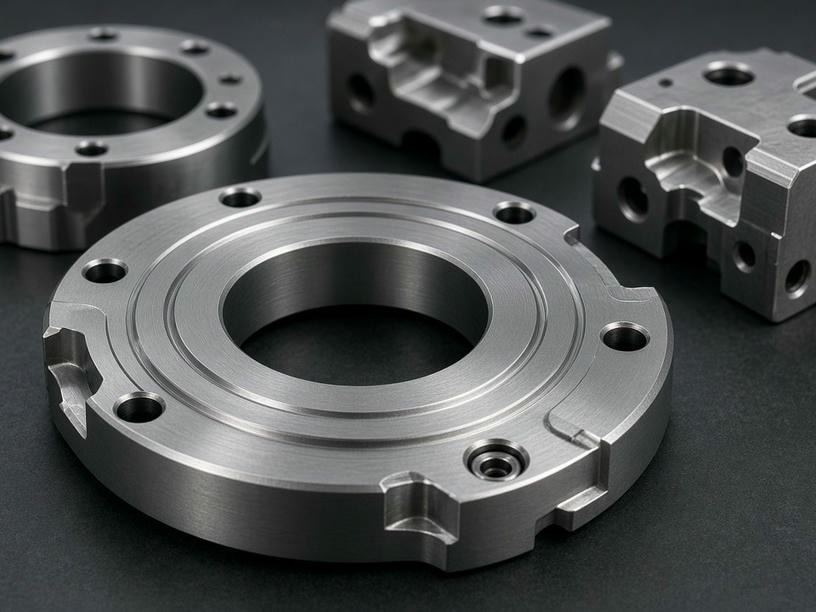
Engineering focus
Strength-to-weight performance, corrosion resistance, and controlled heat during cutting.
Material comparison
Technical Specifications: Titanium Grades
Titanium combines a high strength-to-weight ratio with excellent chemical resistance. Grade 2 is valued for corrosion resistance and moderate machinability, while Grade 5 delivers substantially higher strength for demanding structural applications.
| Property | Grade 2 (CP Ti) | Grade 5 (Ti-6Al-4V) | Engineering relevance |
|---|---|---|---|
| Density | 4.51 g/cm³ | 4.43 g/cm³ | Low mass for performance-driven assemblies |
| Yield Strength | ~345 MPa | ~880 MPa | Grade 5 supports higher structural loads |
| Hardness (HB) | 160 | 330 | Higher hardness increases cutting demands |
| Elastic Modulus | 105 GPa | 114 GPa | Important for deflection and springback control |
| Operating Temperature | Up to 400°C | Up to 400°C | Suitable for demanding service environments |
| Machinability | Moderate | Difficult | Requires controlled tooling and cutting parameters |
Process control
Managing Titanium Machining Challenges
Titanium’s low thermal conductivity keeps heat concentrated at the cutting edge instead of carrying it away with the chips. Our machining strategy is built around thermal control, rigid workholding, and stable tool engagement.
Discuss Your PartHeat Management
High-pressure coolant systems and specialized carbide tooling help prevent work hardening, extend tool life, and protect surface integrity.
Thin-Wall Integrity
Custom work-holding fixtures and optimized tool paths control deflection, warping, and chatter in thin-walled components.
Dimensional Accuracy
Precision tolerances down to ±0.005 mm help complex geometries meet design requirements and reduce secondary rework.
Built for demanding systems
Applications Where Titanium Performs
We support engineering teams requiring lightweight, corrosion-resistant components with dependable performance in high-demand environments.
01 / Aerospace
Lightweight structural hardware
Structural brackets, fasteners, and engine components requiring high fatigue strength and weight savings.
02 / Medical
Corrosion-resistant precision parts
Biocompatible surgical instruments and implants produced with strict adherence to material certification requirements.
03 / Robotics
High-strength moving assemblies
Lightweight linkages and housings for extreme-duty robotic platforms where mass and rigidity both matter.
From prototype to production
Production Flexibility Without Losing Control
Whether you are validating a new design or scaling a proven assembly, our CNC workflow adapts to your volume and documentation needs.
Prototypes
PartsMake processes single-piece orders, enabling rapid design iterations before production commitment.
Repeat Production
Small batches and long-run production are supported with full dimensional reporting and batch traceability.
Secondary Operations
EDM supports complex internal geometries, while precision grinding handles critical mating surfaces.
Quality assurance
Verification Built Around Your Print
Every Titanium component is verified against your drawings and specifications. Our inspection process combines automated measurement, surface evaluation, and complete material traceability.
CMM Inspection
Automated dimensional verification for complex geometries.
Surface Roughness
Ra 0.4–3.2 μm finishes measured to specification.
Material Certification
Full traceability for every Grade 2 or Grade 5 batch.
Quality promise
Reliable documentation for parts that cannot compromise on performance.
From material certificates to dimensional reports, receive the production evidence your quality team needs.
Common questions
Titanium Machining Guidance
Why is Grade 5 more difficult to machine than Grade 2? +
Grade 5 offers approximately 880 MPa yield strength and 330 HB hardness, creating higher cutting loads and greater heat-management demands than Grade 2.
Can you support thin-walled Titanium components? +
Yes. Custom fixtures and optimized tool paths are used to control deflection, chatter, and warping while maintaining dimensional accuracy.
What files should I submit for a quote? +
Submit STEP or IGES files together with technical drawings, material requirements, tolerances, surface finish specifications, and expected quantities whenever available.
Request a quote
Get a Detailed Titanium Manufacturing Proposal
Submit your STEP or IGES files along with technical drawings. Our engineering team reviews each RFQ for manufacturability, cost-saving adjustments, and tolerance challenges before production begins.
Email:
Address:
Start your project review
Share your part data and requirements for a prompt engineering assessment.