Rapid injection molding for product development
Custom Prototype Molding and Rapid Injection Molding Services
Move from CAD to functional, production-grade plastic parts before committing to full-scale tooling. PartsMake helps product teams validate designs with the same engineering materials and realistic molding conditions used in mass production.
±0.03 mm
Precision tolerance
50–800T
Injection capacity
10k+
Prototype mold cycles
100–1M+
Recommended parts
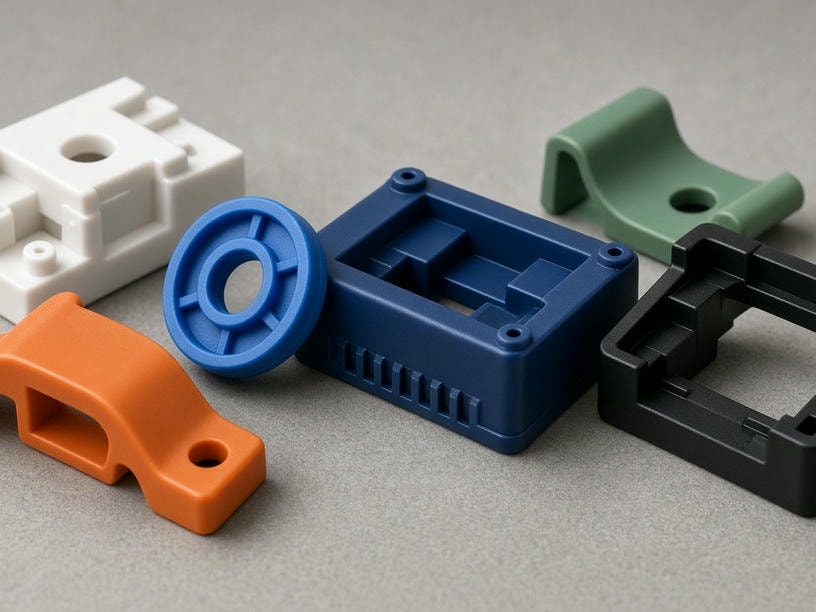
From initial DFM to bridge production
Validate fit, function, materials, finish, and compliance before the production mold is released.
A realistic path to production
Bridge the gap between concept and mass production
Prototype molding provides functional parts that behave more like your final product than machined prototypes. It is especially valuable when geometry, resin behavior, and assembly performance must be verified together.
Discuss your prototype programMaterial integrity
Use actual production resins rather than block materials that may not reproduce injection-molded mechanical properties.
Geometry realism
Validate thin walls, complex forms, snap-fits, ribs, bosses, and other features that are difficult or impossible to machine.
Volume economics
For quantities above roughly 50–100 units, molded unit cost can drop significantly compared with CNC machining.
Engineering decision guide
CNC prototype or prototype molding?
Choose the process that answers the most important question at your current development stage. Use the comparison below as a starting point for your engineering review.
Best for
Design validation, functional testing, bridge production, and pre-market evaluation.
Key advantage
Actual production resins and realistic injection-molded geometry.
Volume signal
Strong value when requirements exceed approximately 50–100 parts.
Rapid tooling parameters
Technical specifications built around your validation plan
Rapid tooling minimizes lead time while preserving the dimensional accuracy required for testing, customer samples, and pre-market evaluation.
| Specification | Prototype molding capability |
|---|---|
| Mold types | Prototype, bridge, and production |
| Mold steel | P20, 718H, NAK80, S136, H13 |
| Maximum mold size | Up to 1000 × 800 mm |
| Injection tonnage | 50–800 ton |
| Typical tolerance | ±0.05–0.20 mm |
| Precision tolerance | Down to ±0.03 mm |
| Mold life | 10,000 to 1,000,000+ cycles |
| Recommended quantity | 100 to 1,000,000+ parts |
Design for manufacturing
Catch tooling risks before cutting metal
Our engineering team performs a comprehensive DFM review to identify molding defects early and reduce avoidable tooling changes. The review includes:
- ●Wall thickness: Improve consistency to prevent sink marks and warping.
- ●Draft angles: Typically 0.5°–2° for efficient part ejection.
- ●Gate placement: Optimize flow and help minimize cosmetic defects.
- ●Ribs and bosses: Support structural integrity while reducing internal stress.
Cost planning
What drives rapid tooling cost?
Prototype molding cost is primarily shaped by mold complexity, steel selection, and cavity count. A single-cavity mold or standardized mold base such as LKM or DME can reduce upfront investment.
Mold complexity
Slides, lifters, undercuts, and surface requirements influence machining and assembly effort.
Steel selection
Choose a material that balances durability, finish, expected cycles, and project timing.
Cavity count
Balance initial mold cost against anticipated production volume and unit economics.
Functional material selection
Match the resin to the test
The right resin helps your prototype produce meaningful results for mechanical, thermal, cosmetic, and assembly validation.
General purpose
ABS, PP, PE/HDPE
Engineering polymers
PC, PC/ABS, POM, PA (Nylon), PBT, PET
High performance
Glass-filled Nylon, PPS, PEEK
Flexible and overmolding
TPU, TPE
Before design freeze
Use molded parts to answer the hard questions
Before committing to high-volume production tooling, prototype parts can expose issues that a drawing review or machined model cannot.
Fit and assembly
Verify tolerances with mating components and confirm assembly sequence.
Functional stress
Evaluate performance under real-world thermal or mechanical loads.
Cosmetic validation
Check SPI A1–D3 and VDI surface finishes, textures, and visual requirements.
Compliance samples
Prepare parts for drop tests, chemical resistance, or electrical insulation certification.
Beyond standard molding
Complete the component and assembly workflow
Our specialized capabilities help reduce handoffs between prototype parts and supply-chain-ready components.
Insert molding
Integrate brass or stainless steel threaded inserts directly into the plastic part.
Overmolding
Combine materials such as a rigid housing with a soft-touch TPU grip.
Secondary finishing
Add painting, laser marking, printing, and full assembly services.
Frequently considered questions
Plan the next tooling decision with confidence
Request your manufacturing quote
Move from CAD file to functional parts
Send your 3D models and project requirements to our engineering department. We will provide a feasibility review, DFM feedback, and detailed lead-time estimates to help keep your project on schedule.
Email:
Location:
Please include technical drawings, material specifications, and anticipated annual usage (AAU) for the most accurate project assessment.