Precision Electropolishing Services
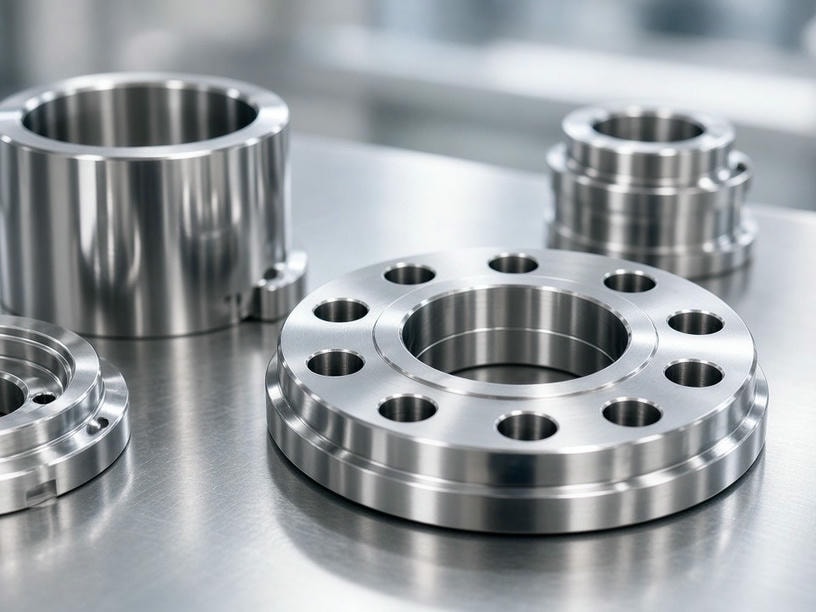
PartsMake provides custom electropolishing services for stainless steel and other alloy components, from engineering review and material selection through controlled electrochemical processing and final dimensional inspection.
Improve surface roughness, cleanliness, corrosion resistance, and micro-deburring performance for medical, semiconductor, food processing, aerospace, and industrial components.
0.005–0.025 mm
Typical material removal
30–50%
Typical Ra reduction
316L
Common high-purity alloy
Controlled process
Clean, passive surfaces for critical components
Surface finish
Smoother Ra profiles
Reduced friction and fewer sites for contaminant adhesion.
Cleanliness
Low-particle surfaces
Removal of oils, scale, impurities, and machining residue.
Protection
Stronger passivation
Chromium-enriched surfaces with improved corrosion resistance.
Process fundamentals
How electropolishing changes the surface
Electropolishing is an electrochemical process that removes surface material from a metal part. The component is immersed in a temperature-controlled electrolyte bath while direct current selectively dissolves the high points of the surface profile.
Engineering review
We evaluate the alloy, drawing tolerances, critical surfaces, geometry, and required surface finish before processing.
Controlled dissolution
Current density, bath temperature, and immersion time are controlled to remove microscopic high points and micro-burrs.
Inspection and release
Finished components are checked for dimensions, Ra performance, appearance, pitting, discoloration, and remaining defects.
Unlike mechanical polishing, which can smear surface metal, electropolishing removes metal ions to create a microscopic, clean, passive surface that reaches complex geometries, internal channels, and threaded areas.
Technical specifications
Parameters built around your print
Standard ranges provide a starting point. Final settings are confirmed against your alloy, initial surface condition, geometry, dimensional tolerances, and required finish.
Design consideration
Because electropolishing removes material, diameter and thickness reductions must be accounted for during initial machining and design review.
| Parameter | Specification / Range |
|---|---|
| Common materials | 304, 316, 316L, 17-4 PH, 400 Series Stainless |
| Material removal | 0.005 mm – 0.025 mm typical |
| Ra improvement | 30% – 50% reduction, depending on initial finish |
| Dimensional impact | Reduction in diameter or thickness; account for removal in design |
| Key benefit | Removes impurities, micro-cracks, and heat tint |
| Primary industries | Medical, Semiconductor, Food Processing, Aerospace |
Functional benefits
A cleaner surface for critical components
Manufacturing engineers use electropolishing to address surface, cleanliness, corrosion, and accessibility requirements that conventional finishing may not solve.
Surface roughness reduction
Smoother surfaces reduce friction and minimize the area where contaminants can adhere.
Enhanced corrosion resistance
The process removes surface iron and inclusions, enriching the surface with chromium oxide and improving passive-layer integrity.
Micro-deburring
Microscopic burrs can be removed from complex geometries, internal channels, and threaded areas where mechanical tools cannot reach.
Surface cleanliness
Electropolishing strips away oils, scale, particulate matter, and residue left from machining or welding as a final cleaning step.
Industry applications
Designed for demanding environments
Parameters are tailored to the performance, cleanliness, and regulatory expectations of each application.
01
Medical and laboratory equipment
For surgical instruments, implants, and laboratory hardware, electropolishing supports biocompatibility, easy sterilization, and removal of machining debris or contaminants.
02
Semiconductor equipment
Vacuum chambers, gas delivery systems, and cleanroom hardware benefit from ultra-clean surfaces that help minimize outgassing and particle generation.
03
Food and beverage processing
Smooth, crevice-free stainless steel surfaces resist cleaning agents, reduce bacterial-harboring areas, and are easier to sanitize.
Engineering before production
Review first. Process with control.
PartsMake evaluates your CAD files and drawings before the electrolyte bath is prepared. This helps protect dimensional intent and identify process requirements early.
Assess dimensional tolerance
Adjust initial machining dimensions to account for material removal and final print requirements.
Verify material compatibility
Confirm the alloy type so the appropriate electrolyte solution and process controls can be selected.
Identify critical surfaces
Define masking or protection requirements wherever material removal must be limited.
Production lifecycle
From prototype to repeat production
The workflow remains consistent whether you need one validation sample or ongoing low-volume supply.
Prototype and engineering samples
Validate surface finish requirements on initial parts.
Pilot production
Fine-tune bath parameters for repeatability across a small batch.
Repeat production
Maintain consistent, documented processes for ongoing supply chain needs.
Quality control
Evidence against your engineering drawings
Inspection confirms that the finished electropolished part meets dimensional, surface, and visual expectations after processing.
Dimensional verification
Micrometer and CMM measurements confirm tolerances remain within print limits after metal removal.
Surface roughness testing
Profilometer testing verifies Ra values against the required surface finish.
Visual inspection
Parts are checked under standard lighting for pitting, discoloration, and remaining surface defects.
Request a quote
Send your electropolishing requirements
Share your technical drawings and requirements with our engineering team. We review files for manufacturability and provide feedback on tolerance adjustments and lead times.
Email:
Address:
Include these details in your RFQ
- ✓CAD files, preferably STEP or IGES
- ✓Material specifications
- ✓Surface finish requirements and Ra
- ✓Dimensional tolerances
- ✓Required production quantities
Contact our engineering team