POM CNC Machining Services for Precision Acetal Parts
Get custom POM parts with low friction, reliable wear resistance, dimensional stability, and clean CNC-machined features. PartsMake supports prototypes, engineering samples, low-volume production, and repeat manufacturing.
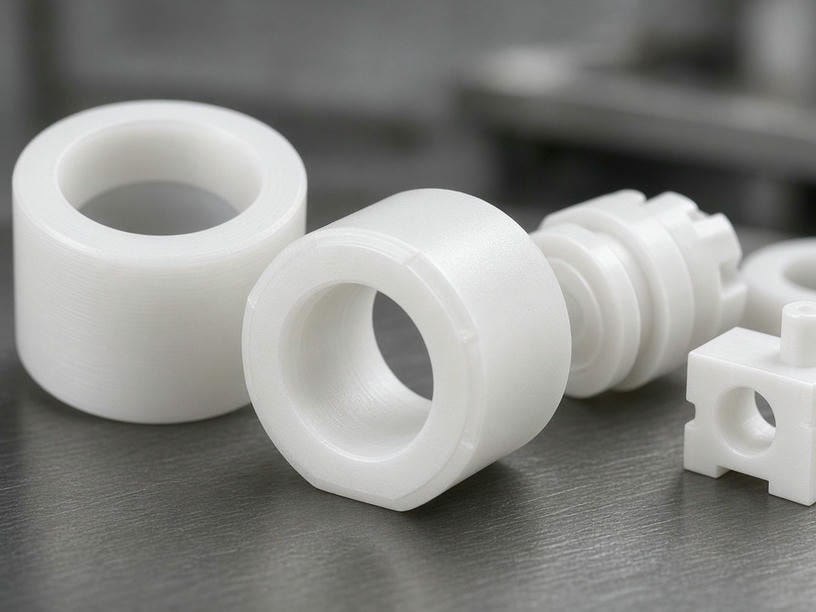
Built for motion and precision
Gears, sliders, bushings, rollers, guides, housings, and precision mechanism parts.
A practical metal alternative for moving parts
POM is widely selected when a part must move, slide, rotate, locate, or support load with less friction than many other engineering plastics. It combines useful stiffness with clean machinability, low moisture absorption, and dependable dimensional performance.
Discuss your application →Low friction and wear
Suitable for dry or lightly lubricated sliding and rotating contact.
Dimensional stability
Lower moisture sensitivity than nylon helps maintain fits and clearances.
Clean machining
Sharp tooling and controlled heat produce fine details and clean edges.
Functional strength
Good stiffness, fatigue resistance, and machinability for mechanical assemblies.
POM machining from one part to repeat production
We machine simple spacers as well as complex acetal components requiring multiple setups, fine details, tight tolerances, threads, press-fit features, and controlled surfaces.
| Capability | Manufacturing range | Typical applications |
|---|---|---|
| CNC milling | 3-axis, 4-axis, 5-axis | Plates, housings, guides, blocks, fixtures |
| CNC turning | Precision and multi-axis turning | Bushings, sleeves, rollers, spacers, pins |
| 5-axis machining | Simultaneous and positional | Multi-face parts and complex mechanisms |
| Mill-turn machining | Milling and turning in one setup | Cylindrical parts with slots, flats, holes, and threads |
| Swiss machining | Up to Ø32 mm | Small pins, shafts, connectors, and miniature parts |
| Grinding | Surface, cylindrical, and centerless | Close-tolerance sliding and mating surfaces |
| Production volume | From 1 to 100,000+ pieces | Prototypes through repeat production |
Available stock includes POM-H, POM-C, black POM, natural POM, food-grade acetal where specified, and customer-specified grades.
POM-H vs POM-C
Both grades are machinable. The right choice depends on strength, creep, fluid exposure, thermal conditions, porosity requirements, and the final application.
POM-H
Higher strength and stiffness, good creep resistance, and excellent machinability. Often selected for precision gears, load-bearing components, and dimension-critical mechanical parts.
POM-C
Better resistance to hot water, chemicals, porosity concerns, and thermal degradation. A practical choice for general machined components, fluid-contact parts, and specified food-grade applications.
Natural and black POM
Natural POM supports easy visual inspection and broad availability. Black POM provides a consistent appearance and may offer improved light resistance depending on the grade. We can quote customer-specified stock.
Typical POM material properties
Values vary by grade, supplier, color, additives, geometry, and test method. Confirm the exact material datasheet for critical applications.
| Property | Typical range | Design relevance |
|---|---|---|
| Tensile strength | Approx. 60–75 MPa | Loaded mechanical parts, clips, gears, and brackets |
| Hardness | Rockwell M80–M90 | Resistance to wear, indentation, and deformation |
| Water absorption | Approx. 0.2–0.8% | Lower moisture sensitivity than nylon |
| Coefficient of friction | Approx. 0.20–0.35 against steel | Sliding, bushings, rollers, and moving mechanisms |
| Continuous service temperature | Typically -40°C to 90–100°C | Many indoor mechanical and industrial applications |
| Short-term temperature | Approx. 120–140°C | Short exposure only; not continuous high-temperature service |
| Linear thermal expansion | 90–120 × 10⁻⁶/°C | Precision fits and temperature variation |
| Typical dimensional change | Low versus many engineering plastics | Toleranced features and mating assemblies |
Parts designed for movement
We pay close attention to fits, surface finish, clearances, and repeatable dimensions for components that slide, rotate, guide, or locate.
Gears and pinions
Quiet, low-friction POM gears for prototypes, repair parts, low-volume mechanisms, and specialty transmission systems. Provide module or pitch, pressure angle, teeth, bore, keyway, and mating gear details.
Sliders and guides
Guide rails, wear pads, positioning blocks, and automation sliders with slots, datum faces, dowel locations, and controlled wear surfaces.
Bushings and sleeves
Turned POM bushings, bearing liners, rollers, and spacers with controlled ID/OD dimensions. Fit depends on shaft size, clearance, load, speed, temperature, and lubrication.
Precision mechanisms
Moving links, detents, insulating components, guides, covers, plates, and low-noise contact parts produced with 4-axis, 5-axis, mill-turn, or Swiss machining.
Precision machining without unnecessary distortion
POM machines well, but tooling, clamping pressure, cutting heat, burr control, and internal stress affect the final part. Our process focuses on stable workholding and inspection of functional features.
- ●Sharp cutting tools and controlled feeds and speeds for clean surfaces.
- ●Stable workholding and machining strategies for thin walls and long features.
- ●Careful deburring and packaging to protect edges and finished plastic surfaces.
- ●Standard tolerance typically ±0.01–0.05 mm; selected precision features down to ±0.005 mm.
Technical CNC capabilities
Achievable tolerance depends on part size, stock condition, temperature, wall thickness, feature geometry, and inspection timing.
Support from first prototype to repeat batch
We review material, geometry, tolerance, and inspection requirements before production so your POM parts perform as intended.
Prototype validation
Functional samples for fit checks, mechanism validation, design verification, and projects not yet ready for molding.
Inspection control
CMM, optical measurement, micrometers, bore and thread gauges, surface roughness measurement, FAI, dimensional reports, and material certificates.
Repeat production
Controlled machining processes, traceability, inspection plans, and batch production for small runs through higher quantities.
Design considerations
- Wall thickness: thicker walls improve stability for loaded, threaded, or precision parts.
- Press and bearing fits: define shaft size, load, temperature, wall thickness, and assembly method.
- Threads: metric, UNC, UNF, BSP, NPT, and custom threads are available; inserts may suit repeated assembly.
- Surface finish: specify roughness and finish direction for sliding surfaces.
- Environment: include operating temperature, humidity, load, speed, and lubrication conditions.
When POM is a good fit
- Low-friction sliding or rotating contact
- Better stability than nylon
- Precision gears and bushings
- Lightweight mechanical performance
- Dry or lightly lubricated mechanisms
- Functional prototypes before tooling
POM may not suit continuous high-temperature service, strong chemical exposure, some UV environments, or applications requiring very flexible impact behavior. We can review demanding conditions before quoting.
Information to include in your quote request
Send as much of the following as possible to reduce back-and-forth and improve material and manufacturability feedback.
- ✓3D CAD: STEP, STP, IGS, or X_T
- ✓2D drawing in PDF format
- ✓POM-H or POM-C requirement
- ✓Natural or black color
- ✓Prototype and production quantity
- ✓Critical tolerances and inspection
- ✓Surface finish and thread details
- ✓Temperature, load, speed, and wear conditions
Need help selecting the material?
If you only have a sample part or preliminary sketch, we can still review the project and advise what is needed for manufacturing. We can also compare POM with nylon, PEEK, PTFE, PC, ABS, UHMW, or other engineering plastics.
Talk to an EngineerPOM machining FAQ
Get your POM machining project reviewed
Send your drawings, CAD files, quantity, material requirement, and inspection needs to PartsMake. We will review manufacturability, tolerances, material selection, and production options.
Email:
Address:
Start with your part details
Upload your design files or describe the required POM component and our team will follow up.