Precision steel finishing
Black Oxide Finish for Precision Steel Parts
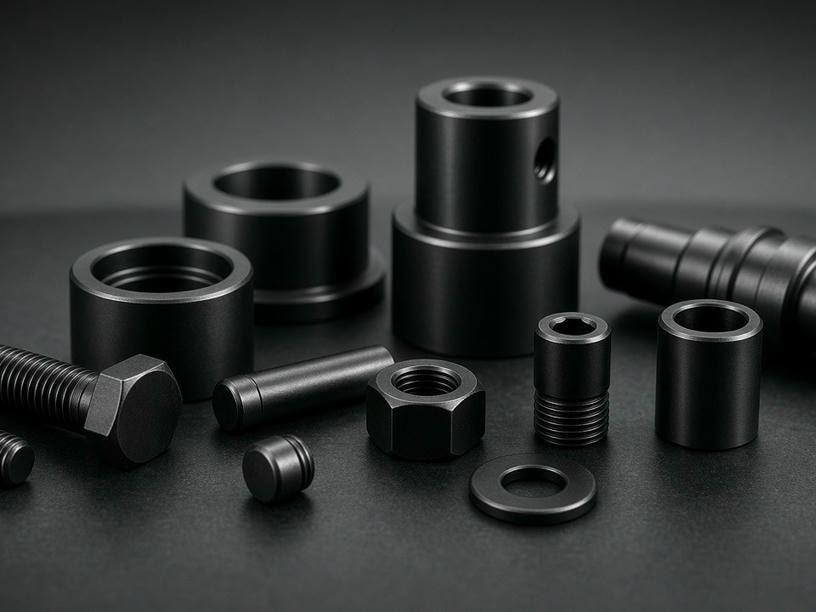
PartsMake manufactures custom steel parts and supplies black oxide finishing for low-dimensional-change, corrosion-resistant, non-reflective components.
We support engineers, OEMs, procurement teams, and product developers that need machined steel parts finished, inspected, and delivered ready for assembly.
0.5–1.5 μm
Typical conversion layer
Low buildup
For threads and fits
Prototype to repeat
Complete supply support
Finish focus
Matte to satin black
Application
Precision steel parts
What we do
Manufacturing and finishing under one quality plan
PartsMake is a custom parts manufacturing partner based in China. We manufacture metal and plastic components from prototype through repeat production.
Black oxide is not handled as an isolated cosmetic step. We review geometry, tolerance stack-up, surface condition, material, masking requirements, and post-treatment before production begins.
Machined steel components
CNC milled, turned, mill-turn, Swiss machined, ground, and EDM-cut parts.
Precision features
Shafts, pins, bushings, sleeves, threaded parts, fixtures, and close-fitting assemblies.
Fabricated steel parts
Sheet metal panels, brackets, covers, frames, and welded assemblies requiring review.
Complete delivery
Secondary finishing, inspection, packaging, assembly, and export shipment.
Process overview
A thin chemical conversion coating for steel
Black oxide converts the surface of ferrous metal into a black iron oxide layer rather than depositing a thick external coating. The result is a dark, low-reflection surface with very small dimensional change compared with paint, powder coating, or plating.
Prepare
Clean, degrease, descale, deburr, blast, polish, or grind according to the steel grade and appearance requirement.
Convert
Apply the selected black oxide process. Hot black oxide commonly operates around 135–150°C; cold alternatives have different durability.
Seal and verify
Apply oil, wax, dry-to-touch sealant, or specified inhibitor, then inspect dimensions, threads, appearance, and packaging.
Engineering parameters
Typical black oxide guidance
Actual results depend on steel grade, heat treatment, surface preparation, process chemistry, and post-sealing method. Use these values as a starting point for RFQ review.
| Parameter | Typical range or result | Precision-part notes |
|---|---|---|
| Film thickness | Approx. 0.5–1.5 μm | Very low buildup for many close-tolerance features |
| Color | Black to deep black | Matte, satin, or slightly glossy depending on sealing and base surface |
| Corrosion resistance | Mild to moderate with oil, wax, or sealant | Not a stand-alone outdoor corrosion protection system |
| Suitable steel | Carbon, alloy, tool, and some stainless steels | Confirm grade and process compatibility before production |
| Process temperature | Hot process commonly 135–150°C | Cold blackening alternatives offer different durability |
| Post-sealing | Oil, wax, dry-to-touch sealant, or inhibitor | Critical for corrosion resistance and handling performance |
| Dimensional change | Very low compared with plating or paint | Often preferred for threads, shafts, pins, bores, and assemblies |
Precision advantage
Designed for threads, mating surfaces, and low dimensional change
Many finishing processes add measurable thickness. That can affect thread engagement, press fits, bearing seats, dowel holes, ground diameters, and precision slots. Black oxide is frequently selected when a dark surface is required without significant coating buildup.
- ●Fine pitch internal and external threads
- ●Ground shafts, pins, and bearing seats
- ●Bushings, sleeves, spacers, and fixtures
- ●Robotic, optical, and automation hardware
- ●Low-reflection machine components
- ●Precision fasteners and locating elements
Thread and feature controls
Low dimensional change does not remove the need for process control. Burrs, thread deformation, trapped chemicals, and post-treatment oil can affect assembly.
Specify whether the part must remain oil-free or dry-to-touch. Some post-seals improve corrosion protection but leave an oily surface.
Finish selection
Black oxide or black zinc?
Both finishes create black steel components, but they are not interchangeable. Compare dimensional requirements, corrosion exposure, appearance, and service conditions before approving the process.
Choose black oxide when fit is the priority
- • Dimensional change must be minimal.
- • Threads, bores, or mating surfaces are critical.
- • A dark, low-reflection steel surface is required.
- • The part is mainly used indoors or in a controlled environment.
- • The part will be oiled, maintained, or protected in storage.
Typical profile
- Buildup
- Very low
- Corrosion protection
- Mild to moderate
- Surface
- Matte to satin black
Choose black zinc when exposure is the priority
- • Corrosion resistance matters more than minimum buildup.
- • The part will face humidity, handling, or storage exposure.
- • The drawing allows plating thickness.
- • Thread tolerances can accommodate the zinc layer.
- • Sacrificial zinc protection is required.
Typical profile
- Buildup
- Higher than oxide
- Corrosion protection
- Generally better
- Surface
- Black to dark iridescent
If the drawing only says “black finish,” clarify the expected performance before production. We can also compare zinc nickel, nickel plating, phosphate, painting, powder coating, passivation, or other treatments.
Manufacturing capability
Parts made before finishing, with quality planned from the start
PartsMake controls the machining marks, burrs, thread condition, surface roughness, material selection, and inspection points that influence black oxide quality.
CNC milling
3-axis, 4-axis, and 5-axis plates, brackets, fixtures, and housings.
CNC turning
Shafts, pins, sleeves, bushings, and threaded steel parts.
Mill-turn and Swiss
Multi-feature parts and small precision components up to Ø32 mm.
Grinding and EDM
Tight mating surfaces, hardened profiles, keyways, slots, and complex shapes.
Sheet metal
Cutting, bending, welding, and assembly for steel panels and frames.
Finishing
Black oxide, plating, anodizing, passivation, painting, and other treatments.
Inspection
Dimensional, material, thread, hardness, surface, and functional checks.
Delivery support
Assembly, corrosion-preventive packaging, and export shipment.
Pre-production review
Identify finishing risk before material is cut
Finish quality can be affected by machining oil, rust, heat-treatment scale, blind holes, threads, sharp corners, welds, and mixed materials. Our engineering review covers:
- • 2D drawings and 3D CAD files
- • Material grade and hardness
- • Critical dimensions and tolerance zones
- • Thread specifications and gauges
- • Surface roughness and edge breaks
- • Masking or finish exclusion areas
- • Cosmetic expectations and samples
- • Quantity and repeat production needs
- • Inspection reports
- • Packaging and shipment protection
Issues we check early
Drainage and entrapment
Blind holes, internal threads, and cavities must drain and be cleaned properly.
Surface condition
Black oxide follows the base surface and does not hide scratches, dents, scale, or tool marks.
Material compatibility
Welded areas, mixed-metal assemblies, inserts, and stainless grades may require special review.
Handling and storage
Choose oil, wax, dry-to-touch sealant, VCI, oil paper, or anti-rust bags for the service and shipping environment.
Quality and delivery
From prototype to repeat production
Black oxide projects often begin with engineering samples so teams can confirm fit, appearance, handling condition, and corrosion protection before scaling production.
We can supply one-off prototypes, small sample batches, low-volume production, blanket orders, mixed part-family packages, and machining-plus-finishing programs.
Inspection options
- • Dimensional inspection reports
- • First article inspection
- • CMM inspection
- • Thread gauge inspection
- • Surface roughness checks
- • Visual finish inspection
- • Material and hardness verification
- • Functional gauge checks
- • Batch inspection records
- • Packaging inspection
Applications
Suitable materials, parts, and industries
Common candidate materials include low and medium carbon steel, alloy steel, tool steel, heat-treated steel, and certain stainless steels with suitable process selection.
Parts commonly supplied
- • CNC machined blocks and brackets
- • Fixture plates and tooling hardware
- • Shafts, pins, and spacers
- • Bushings and sleeves
- • Precision fasteners
- • Robot end-effectors
- • Machine housings and covers
- • Lab and test equipment hardware
Medical, aerospace, safety-critical, or regulated applications should include all relevant standards and inspection requirements during RFQ.
RFQ checklist
Send the information needed for an accurate quote
Share as much of the following as possible. If you are unsure whether black oxide is the correct finish, include the application and service environment so we can compare alternatives.
- • 2D drawing in PDF format
- • STEP, IGES, or native CAD file
- • Material grade and hardness
- • Quantity and annual volume
- • Finish requirement or standard
- • Oil, wax, or dry-to-touch preference
- • Critical dimensions and threads
- • Inspection and packaging needs
- • Cosmetic requirements or samples
- • Target delivery date
Common finishing alternatives
Depending on the application, we can review black zinc, zinc nickel, nickel plating, phosphate, passivation for stainless steel, painting, powder coating, or other surface treatments.
Send Drawings for ReviewFrequently asked questions
Black oxide engineering answers
Request a quote
Get black oxide parts ready for assembly
Send your drawings, CAD files, material, quantity, and finishing notes. We will review geometry, tolerances, finish requirements, production quantity, inspection needs, and corrosion-prevention packaging before quoting.
Company: PartsMake
Email:
Address: