Carbon Steel Parts Built for Strength, Cost, and Production Scale
Carbon steel remains the industry standard for industrial components requiring high mechanical strength, structural integrity, and cost-effective production. PartsMake processes 1018, 1045, A36, and other common grades for mechanical assemblies, structural frames, and heavy-duty hardware.
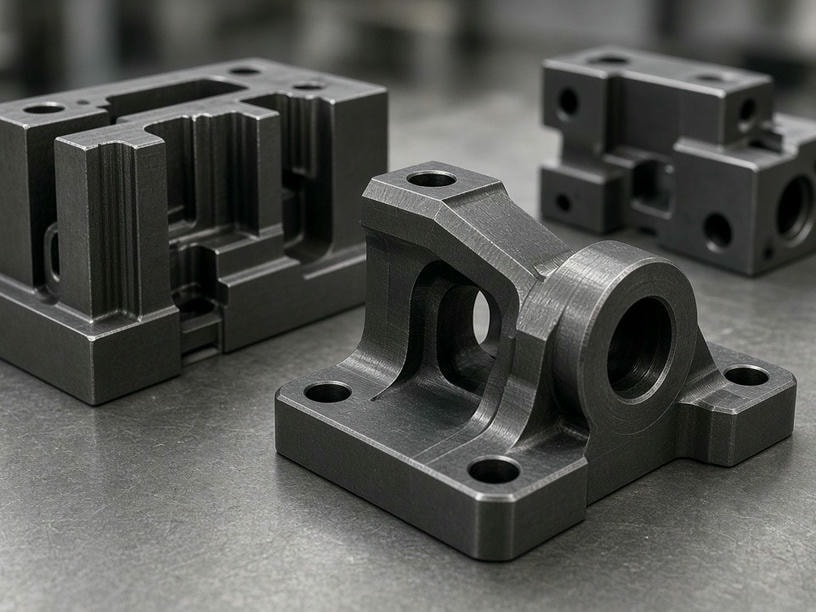
Engineering-led production
From one-off prototypes to production runs, dedicated CNC and sheet metal workflows help balance part performance with manufacturing cost.
Why carbon steel
A practical choice for demanding industrial parts
Carbon steel offers superior machinability compared to stainless steel and higher structural capacity than many aluminum alloys. This combination makes it well suited to high-load applications where material cost, strength, and reliable production all matter.
Lower material cost
An economical foundation for prototypes, assemblies, frames, and larger production programs.
High load capacity
Suitable for shafts, gears, brackets, housings, and structural components exposed to demanding loads.
Flexible processing
Compatible with CNC machining, laser cutting, bending, welding, assembly, and protective finishes.
Manufacturing workflows
One carbon steel partner for machined and fabricated parts
Select the production route that matches your geometry, volume, and tolerance requirements. Our engineering team can review the design and help identify a cost-effective process.
01 / CNC
Precision CNC machining
Our CNC department handles carbon steel components ranging from simple pins and bushings to complex, multi-axis milled housings.
- ●Milling: 3-axis, 4-axis, and simultaneous 5-axis machining for complex geometries and tight-tolerance surfaces.
- ●Turning: Multi-axis turning and mill-turn operations for shafts, rollers, and cylindrical components.
- ●Swiss machining: High-precision production for small-diameter parts up to Ø32 mm requiring high throughput.
02 / Fabrication
Carbon steel sheet metal
For enclosures, chassis, brackets, and structural frames, fiber laser cutting and precision bending provide clean edges and consistent bend angles for welding and assembly.
- ●Laser cutting: High-speed fiber laser cutting for profiles and complex openings with a typical tolerance of ±0.10 mm.
- ●CNC bending: Press brake capacity up to 200 tons for large-scale forming.
- ●Welding and assembly: TIG, MIG, spot, and laser welding, plus PEM nuts, studs, and standoffs.
Material selection
Choose the grade around the part’s job
The right carbon steel grade affects mechanical performance, weldability, machining time, and total manufacturing cost. Use the comparison below as a starting point for your design review.
| Grade | Carbon content | Strength | Hardness | Machinability | Weldability | Typical applications |
|---|---|---|---|---|---|---|
| 1018 | 0.15–0.20% | Low | Low | Excellent | Excellent | Pins, shafts, rods, fixtures |
| 1045 | 0.43–0.50% | Medium | Medium | Good | Moderate | Gears, axles, heavy-duty parts |
| A36 | ≤ 0.29% | Low | Low | Good | Excellent | Structural frames, brackets, bases |
1018
Best for general machining and parts requiring case hardening. Its low carbon content also supports easy welding.
1045
Provides higher tensile strength for wear-prone components and responds well to induction hardening.
A36
The economical standard for large sheet metal fabrications, welded frames, brackets, and bases.
Finish and durability
Protect carbon steel from oxidation
Carbon steel is susceptible to oxidation. Select a protective treatment based on corrosion exposure, dimensional requirements, appearance, and the part’s operating environment.
Black oxide
A mild corrosion-resistant finish with minimal dimensional change, ideal for internal machine components.
Zinc plating
Provides sacrificial corrosion protection and is commonly used for fasteners and structural brackets.
Nickel plating
Creates a harder, more decorative, and corrosion-resistant surface for selected industrial parts.
Powder coating
Recommended for cosmetic enclosures and parts exposed to environmental elements, with multiple colors and textures available.
Quality assurance
Inspection that follows the part from material to shipment
Every production batch undergoes rigorous inspection to ensure compliance with your engineering drawings, tolerances, and material specifications.
Request inspection documentation →Inspection tools
CMM inspection, optical measurement, micrometer, and bore gauge verification.
Reporting
Full dimensional reports and material certificates provided upon request.
Traceability
Complete batch tracking from raw material procurement to final shipment.
Request a quote
Send your carbon steel project for engineering review
Provide your CAD files and technical drawings. Our engineering team reviews every RFQ to identify opportunities for cost reduction or manufacturing efficiency before providing lead time and pricing.
Tell us about your part
Share your requirements with our team and we will follow up with the next steps.