Custom POM Injection Molding for Industrial Components
From DFM and mold design to mass production and assembly, PartsMake manufactures high-precision POM components for mechanical and automotive applications.
50–800 ton
Injection molding capacity
±0.03 mm
Precision tolerance capability
24–48 h
DFM and estimate response
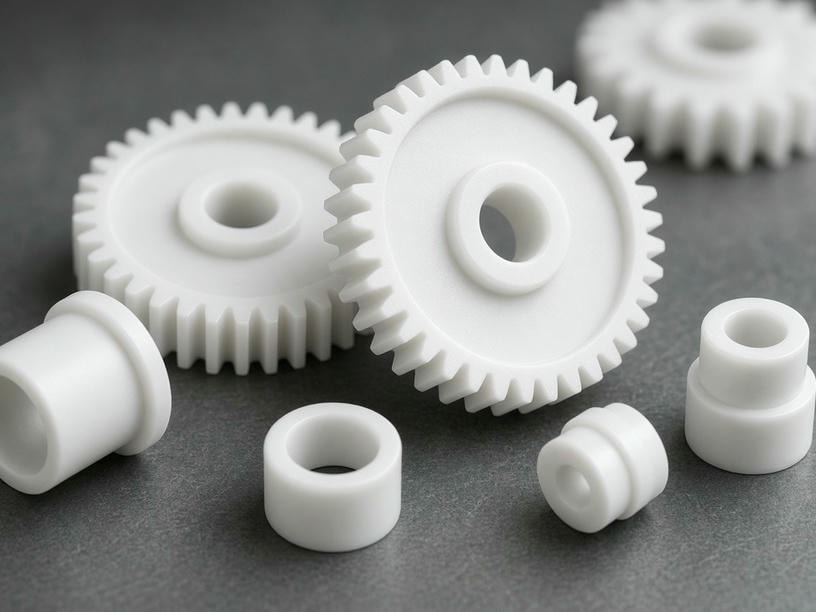
Built for mechanical performance
Low friction, high stiffness, fatigue resistance and controlled dimensional stability for demanding moving assemblies.
Material expertise
Control crystallinity, shrinkage and long-term fit
POM is valued for its low friction, high stiffness and natural lubricity. Its high crystallinity, however, can create significant mold shrinkage and dimensional variation if the tool and process are not engineered together.
Our engineering team manages both POM-C copolymer and POM-H homopolymer grades, selecting the right approach for tolerance, fatigue, wear and production requirements.
POM-C copolymer
A balanced option for dimensional stability, chemical resistance and reliable performance in clips, guides and sliding components.
POM-H homopolymer
A strong choice where higher stiffness, strength and wear performance are important for precision gears and load-bearing mechanisms.
Engineering focus
Shrinkage compensation is considered during mold design, while injection parameters and cooling are controlled to reduce warpage and protect critical dimensions.
Process window
Technical POM molding parameters
These engineering ranges provide a starting point for material selection, mold compensation and process validation. Final settings are confirmed through tooling trials and dimensional inspection.
| Parameter | Typical range or capability | Engineering consideration |
|---|---|---|
| Melting temperature | 180°C–210°C | Set according to grade and flow requirements. |
| Mold temperature | 60°C–120°C | Optimized to manage crystallinity and dimensional consistency. |
| Typical shrinkage | 1.5%–2.5% | Compensated through mold design and process control. |
| Recommended wall thickness | 1.0–3.0 mm | Consistent walls help limit stress, warpage and uneven cooling. |
| Mechanical performance | High fatigue resistance, low creep and natural lubricity | Suitable for repeated mechanical operation and sliding contact. |
Precision applications
Designed for gears, clips and sliding mechanisms
POM components often sit at the center of a mechanical assembly. We focus on the fit, movement and repeatability of the complete application—not only the molded part.
01 / Gear accuracy
Involute profiles with controlled fit
Mold compensation and dimensional inspection support tight tolerances for POM gears and other power-transmission profiles.
02 / Snap-fit reliability
Clips that withstand repeated use
DFM review identifies stress concentrations and supports reliable snap-fit connectors with appropriate wall thickness and draft.
03 / Low-friction motion
Smooth sliding mechanisms
Controlled surfaces and stable processing help produce guides, bushings and slides for high-cycle mechanical operation.
Mold engineering
Shrinkage compensation starts before steel is cut
Every project begins with a Design for Manufacturing review. We assess wall thickness, draft angles, gating positions and stress concentrations that could affect the long-term performance of gears or snap-fit connectors.
Cooling-channel planning and gate location are selected to support balanced filling, predictable crystallization and reduced warpage in complex geometries.
01
DFM analysis
Identify molding risks before tooling begins.
02
Mold design
Plan gates, cooling and dimensional compensation.
03
Tool manufacture
Use CNC machining, EDM and precision grinding.
04
T1 validation
Complete first-article inspection and reporting.
Manufacturing capabilities
From prototype tooling to production scale
PartsMake supports projects from small precision clips to larger structural housings with 50–800 ton injection molding machines.
End-to-end delivery
Production support beyond the mold
After molding, we can provide CNC machining for features that cannot be molded, laser marking for part identification and full-scale assembly of sub-components.
Insert molding is also available to overmold plastic onto brass or stainless steel inserts for stronger threaded connections.
CNC machining
Finish features that cannot be molded directly.
Laser marking
Add identification and traceability details.
Assembly
Receive ready-to-use mechanical subassemblies.
Additional material options
Request a quote
Send your POM project for engineering review
Share your 3D CAD files in STEP, IGS or X_T format together with your technical requirements. Our engineering team will review the project and respond with a DFM report and production estimate within 24–48 hours.
PartsMake
- Address