Industrial laser cutting services
Precision Laser Cutting Services for Custom Sheet Metal Components
PartsMake converts CAD designs into high-precision metal components for product developers and procurement teams, from initial prototypes to high-volume production runs.
±0.05 mm
Precision available upon request
3000 × 1500
Maximum sheet size in mm
Technical specifications
Cutting capacity built around consistent edge quality
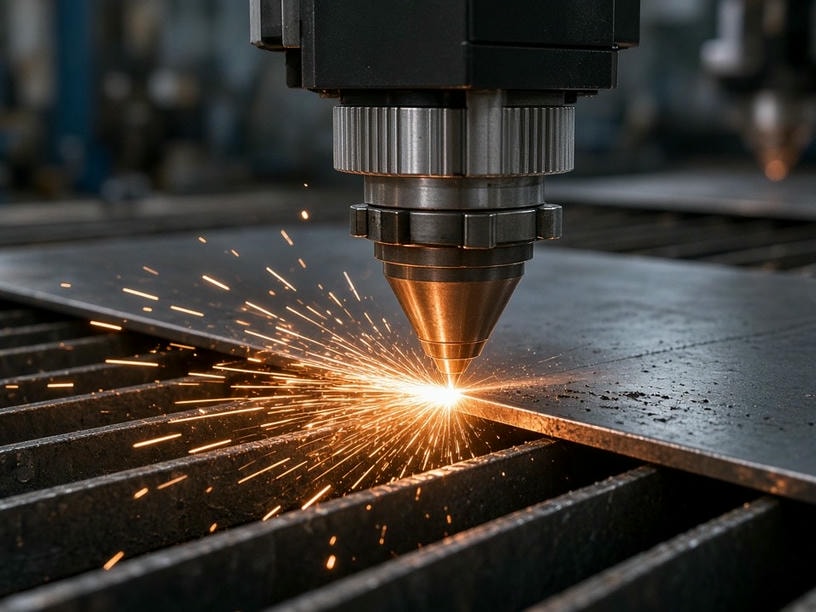
Our high-power fiber laser systems process ferrous and non-ferrous materials while focusing on dimensional accuracy, controlled kerf width, and a minimized Heat Affected Zone (HAZ).
| Material | Max thickness | Minimum hole diameter | Typical tolerance | Typical kerf width |
|---|---|---|---|---|
| Carbon Steel | 25 mm | Approximately 1:1 to thickness | ±0.10 mm | 0.1–0.3 mm |
| Stainless Steel | 20 mm | Approximately 1:1 to thickness | ±0.10 mm | 0.1–0.3 mm |
| Aluminum | 20 mm | Approximately 1:1 to thickness | ±0.10 mm | 0.1–0.3 mm |
| Copper | 10 mm | Approximately 1:1 to thickness | ±0.10 mm | 0.1–0.3 mm |
| Brass | 10 mm | Approximately 1:1 to thickness | ±0.10 mm | 0.1–0.3 mm |
Maximum sheet size
3000 × 1500 mm
Precision option
Down to ±0.05 mm
Hole-to-thickness guideline
Approximately 1:1
Thermal control
Nitrogen or oxygen: choose the edge finish your application needs
Assist gas affects cut speed, oxidation, edge appearance, and the downstream preparation required before welding, painting, or plating.
Nitrogen cutting
An inert process used primarily for stainless steel and aluminum. It prevents oxidation and produces a clean, silver-colored edge that is ready for welding or powder coating without secondary grinding.
Oxygen cutting
A reactive process used primarily for thicker carbon steel. The exothermic reaction assists penetration, while the resulting oxide layer may require mechanical cleaning before painting or plating.
Design for results
Geometry decisions that protect accuracy
Small changes to hole sizes, spacing, and corners can reduce distortion, improve edge quality, and support repeatable production.
Hole diameter
Avoid holes smaller than the material thickness. Undersized holes can become conical or develop slag buildup.
Part spacing
Maintain spacing at least equal to the material thickness to help prevent heat warping and preserve sheet stability.
Corner radii
Add a small radius to internal corners instead of sharp 90-degree turns to reduce stress concentrations and improve path flow.
File preparation
Prepare clean DXF files for a faster quotation
Efficient production starts with geometry that can be read accurately by nesting and cutting software.
Send Your CAD FilesUse 1:1 scale
Export DXF or DWG files at a 1:1 scale in millimeters.
Close every contour
Use closed polylines for all profiles. Open paths and overlapping lines can create nesting errors.
Remove drawing annotations
Leave out dimensions, text, and title blocks from the profile file.
Separate bend information
Provide a separate file or a clear layer for bend lines and bend direction.
Edge quality and inspection
Quality control from contour to finished part
PartsMake reviews material properties, grain direction, and thermal stress before production. The goal is a stable process that delivers the specified contour and edge condition.
Dimensional verification against CAD data
Material certification and traceability
Inspection of cut edge quality and burr removal
Practical edge quality levels
Clean inert edge
Silver-colored, oxidation-controlled edge suited to stainless steel and aluminum applications requiring a clean downstream surface.
Reactive steel edge
Oxygen-assisted edge for thicker carbon steel, with an oxide layer that may need cleaning before coating or plating.
Production-ready finish
Cut parts are checked for dimensional conformity, edge condition, and burr removal against the project requirements.
Complete fabrication partner
Go beyond cutting with integrated secondary processes
Combine laser-cut components with downstream fabrication to simplify sourcing and receive finished assemblies from one manufacturing partner.
CNC bending
Up to 200 tons capacity with 3000 mm length.
Hardware insertion
Automated installation of PEM nuts, studs, and standoffs.
Welding
TIG, MIG, spot, and laser welding for structural or cosmetic requirements.
Surface finishing
In-house powder coating, anodizing, and plating services.
Applications
Built for demanding technical sectors
We support teams that need repeatable sheet metal components, controlled contours, and dependable production feedback.
Robotics & automation
Structural frames and mounting brackets.
EV & new energy
Busbars, heat sinks, and battery enclosures.
Medical equipment
Precision panels and chassis.
Industrial machinery
Heavy-duty machine guards and components.
Frequently requested guidance
Clear answers before production starts
Share your material grade, thickness, finish, and assembly requirements so our engineering team can review risks early.
What determines the final hole quality?
Hole diameter, material thickness, assist gas, and the cutting setup all affect whether a hole remains cylindrical and free from excess slag. As a starting point, avoid holes smaller than the material thickness.
When is nitrogen preferred?
Nitrogen is primarily used for stainless steel and aluminum when oxidation control and a clean silver-colored edge are important for welding, powder coating, or appearance.
What should I include in a quote request?
Include technical drawings, 3D models, DXF files, material grade, thickness, surface finish, quantity, and any assembly requirements.
Request a quote
Send your design for an engineering review
Send your technical drawings, 3D models, and DXF files to . Include material grade, surface finish, and assembly requirements. Our team will review your documentation and provide a lead-time estimate and manufacturing feedback within 24 hours.
PartsMake
Email: