Precision Heat Treatment for Custom Metal Components
PartsMake integrates heat treatment into the complete manufacturing lifecycle to help custom components meet precise hardness, wear resistance, strength, and structural requirements.
From prototype development to high-volume production, our engineering and procurement support helps ensure the selected thermal process is aligned with your material, geometry, and end-use performance.
Prototype to production
Thermal processing aligned with your volume.
Material-focused
Process selection based on alloy and loading.
Verified results
Hardness and dimensional inspection included.
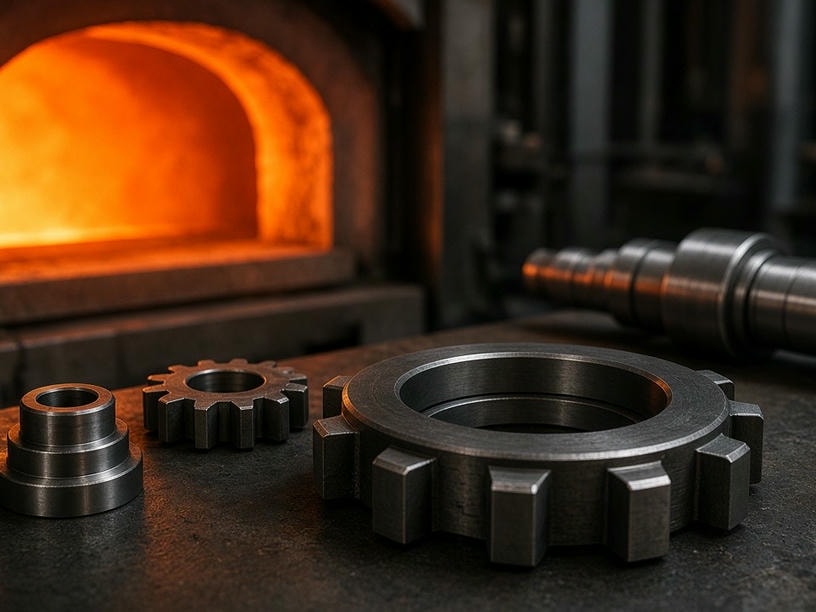
Performance-led processing
Improve strength, toughness, machinability, and surface performance without changing the intended part geometry.
Why it matters
Heat treatment changes performance at the microstructural level
Heat treatment is not a cosmetic finish. By controlling heating and cooling cycles, it modifies the metal's microstructure to increase tensile strength, relieve internal stress, improve machinability, or enhance surface hardness.
For B2B components, choosing the correct thermal process can be as important as choosing the base material. Incorrect cycles may cause material failure, premature wear, brittleness, or unexpected dimensional change.
01
Strength
Increase load-bearing capability for demanding applications.
02
Durability
Improve wear resistance and fatigue life.
03
Stability
Control internal stress before final tolerances are set.
Process selection matrix
Heat treatment capabilities and applications
We manage thermal processing protocols according to the alloy, target properties, component geometry, and operating conditions.
| Process | Typical materials | Hardness / outcome | Primary purpose |
|---|---|---|---|
| Quenching | Carbon and alloy steels | Significant increase in hardness | Maximize strength and hardness |
| Tempering | Quenched steels | Reduced brittleness, improved toughness | Balance hardness and ductility |
| Annealing | Steel, copper, aluminum | Increased ductility, reduced internal stress | Improve machinability |
| Solution treatment | Aluminum alloys | Homogenized microstructure | Prepare for precipitation hardening |
| Aging | Aluminum alloys | Increased yield strength | Achieve peak mechanical strength |
| Carburizing | Low-carbon steels | Hard surface, tough core | Wear resistance with impact toughness |
| Nitriding | Alloy steels, stainless steels | High surface hardness, corrosion resistance | Wear resistance and fatigue life |
Dimensional control
A CNC-to-heat-treatment workflow built around tolerances
Metals expand and contract during thermal processing. Our sequence accounts for possible warping and distortion before final dimensions are established.
-
1
Rough machining
Machine with an allowance to compensate for potential deformation.
-
2
Heat treatment
Apply the specified thermal cycle for the required material properties.
-
3
Stress relief or straightening
Stabilize geometry when secondary stress relief or correction is required.
-
4
Finish machining or grinding
Remove the allowance and establish the final precise dimensions.
Ferrous metals
We assess carbon content and alloying elements to determine hardenability for quenching, tempering, carburizing, and related processes.
Typical focus areas
- •Target hardness and toughness balance
- •Case depth and surface performance
- •Distortion risk after machining
Non-ferrous metals
For aluminum alloys, we manage solution and aging parameters to achieve T6 or T7 temper states while maintaining structural integrity under operational loads.
Engineering support includes
- •Material and temper compatibility review
- •Strength and load requirement alignment
- •CAD-based process risk evaluation
Engineering recommendation
Not sure which alloy or treatment fits your application?
Share your design requirements and we can recommend a suitable process for high-stress robotics components, wear-resistant automotive pins, and other precision parts.
Integrated production lifecycle
One documented workflow from machining to verification
We do not treat heat treatment as an isolated task. By coordinating in-house operations or vetted supply-chain partners with CNC machining, grinding, and surface finishing, PartsMake reduces logistics time and communication risk.
01 / Review
Drawings and materials
Review CAD files, alloy specifications, tolerances, and target properties.
02 / Coordinate
Thermal processing
Synchronize the specified thermal cycle with the manufacturing plan.
03 / Document
Production records
Track thermal processing parameters as part of total manufacturing documentation.
04 / Scale
Repeatable output
Support single prototypes or production runs of thousands of parts.
Quality control
Post-treatment verification is mandatory
We verify that the material and geometry meet the specified requirements after thermal processing, including the effects of shrinkage or distortion.
Hardness testing
Rockwell HRC/HRB or Vickers HV testing verifies the target hardness range.
Dimensional inspection
Post-treatment measurement confirms the part remains within tolerance.
Microstructural analysis
Cross-sectional inspection verifies case depth and uniformity for carburized or nitrided parts.
Technical questions
Heat treatment guidance for your RFQ
Request a quote
Specify the performance your component needs
Send your drawings, material specifications, and heat treatment requirements, such as target hardness or applicable standard. Our engineering team will review your documentation, identify manufacturing risks, and verify that the thermal process is suitable for your part geometry.
Email:
Facility:
Project inquiry