Custom ABS Injection Molding Services
PartsMake provides end-to-end ABS plastic injection molding for industrial, electronic, and consumer applications—from DFM and mold design through secondary finishing and high-volume production.
50–800 tons
Injection molding range
±0.05–0.20 mm
Standard tolerances
1 g–5 kg
Part weight capacity
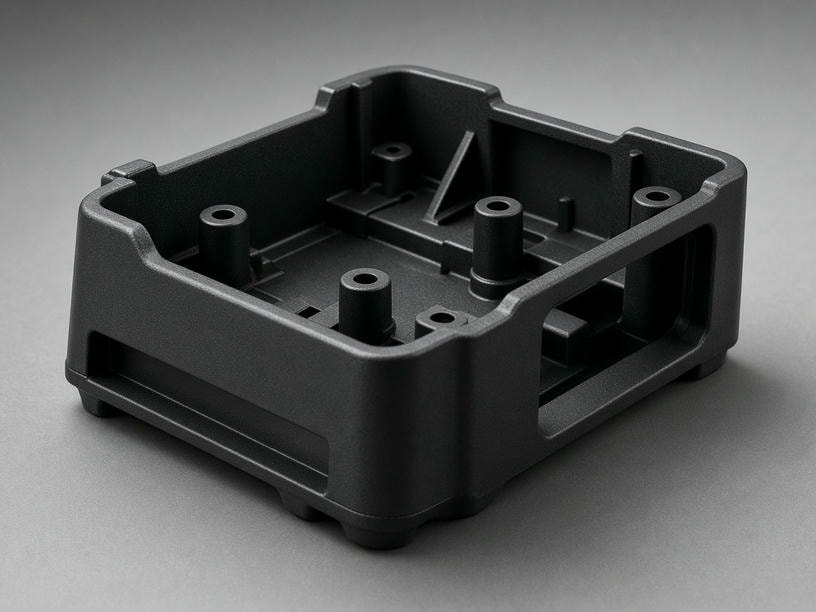
Built for demanding housings
Complex thin-wall geometries, consistent cosmetic surfaces, and production-ready finishing.
Material advantage
Why ABS is preferred for housings
ABS combines balanced mechanical properties, high impact resistance, and excellent processability. Its strong flow characteristics support complex geometries and thin walls for durable housings, enclosures, and structural components.
Reliable flow
Well-controlled ABS flow helps fill detailed features and thin-wall sections while supporting repeatable production.
Surface-ready finish
Correctly processed ABS provides a clean surface for painting, laser marking, screen printing, and texturing.
Impact performance
The material’s impact resistance makes it suitable for protective enclosures and everyday-use products.
Design flexibility
ABS supports functional prototypes, consumer electronics, industrial housings, and scalable production programs.
Process control
Technical parameters for ABS processing
Thermal management throughout the injection cycle is critical to dimensional stability, structural integrity, and cosmetic quality. These recommended specifications guide material preparation and mold setup.
| Parameter | Recommended specification |
|---|---|
| Melt temperature | 200°C–250°C |
| Mold temperature | 50°C–80°C |
| Mold shrinkage | 0.4%–0.7% |
| Recommended wall thickness | 1.0 mm–3.0 mm |
| Minimum wall thickness | 0.5 mm |
| Draft angle | 0.5°–2° |
| Drying conditions | 80°C for 2–4 hours |
Engineering support
DFM analysis focused on ABS performance
Before tooling begins, our engineering team reviews geometry, filling behavior, cooling, ejection, and downstream finishing requirements to reduce avoidable defects.
Discuss your designPrevent sink marks
Rib thickness is typically optimized to 50%–60% of the nominal wall to reduce surface depressions and improve cosmetic consistency.
Control weld lines
Gate locations are positioned to move knit lines into non-critical areas where possible. Injection speed and pressure are reviewed to minimize their visual and structural impact.
Specify the right surface
SPI A1–D3 finishes and VDI textures can be selected to achieve the required matte, textured, or glossy appearance.
Prepare for painting
Mold release agents and surface conditions are selected with downstream paint adhesion in mind, helping prevent coating defects and delamination.
Production capability
From prototype tooling to mass production
A connected manufacturing workflow keeps tooling, molding, inspection, and finishing aligned with your production requirements.
Mold making
In-house prototype, bridge, and production molds using P20, 718H, and NAK80 steel.
Precision molding
Standard tolerances of ±0.05–0.20 mm, with precision capabilities reaching ±0.03 mm.
Integrated features
Insert molding, overmolding, and brass or stainless steel threaded inserts for functional assemblies.
Scalable tooling
Mold life from 10,000 to over 1,000,000 cycles to match project volume and service expectations.
Beyond the molding press
Ready-to-assemble ABS components
PartsMake provides integrated secondary services to support complete product delivery. Our quality control department performs dimensional and cosmetic inspections so every batch matches your engineering specifications.
Laser marking
Precision branding, identification, and traceability marks.
Screen printing
Graphics and functional markings for product interfaces.
Industrial painting
Surface preparation and coating support for finished housings.
Quality inspection
Dimensional and cosmetic checks against approved specifications.
Project suitability
A practical material choice for evolving programs
ABS injection molding is suited to projects that require a balance of cost efficiency and performance. It can support functional prototypes for testing as well as high-volume consumer electronics and industrial production.
When an application requires higher heat resistance or specific chemical properties, our team can help evaluate reinforced ABS grades or alternative engineering polymers.
Prototype
Validate form, fit, and function.
Scale-up
Transition to repeatable tooling.
Production
Maintain consistency at volume.
ABS questions
Planning considerations
How can ABS housings be designed to reduce sink marks? +
Keep ribs near 50%–60% of the nominal wall thickness, avoid heavy sections, and review cooling and packing behavior during DFM.
Where should weld lines appear? +
Gate placement should direct knit lines away from highly visible or highly stressed areas. Flow analysis and injection settings can further reduce their impact.
What improves paint adhesion on ABS? +
Define the required paint system early, control mold release selection, and specify an appropriate surface texture and preparation process before production.
Start your project
Request an ABS molding review
Submit your 3D models in STEP or IGS format together with volume requirements and material specifications. Our team will provide a technical assessment, accurate lead time, and cost analysis.
Technical inquiry
Share your project details with our engineering team.