PBT Injection Molding Services for Demanding Industrial Applications
PartsMake provides end-to-end injection molding solutions for Polybutylene Terephthalate components, from DFM analysis and tooling through high-volume production and secondary finishing.
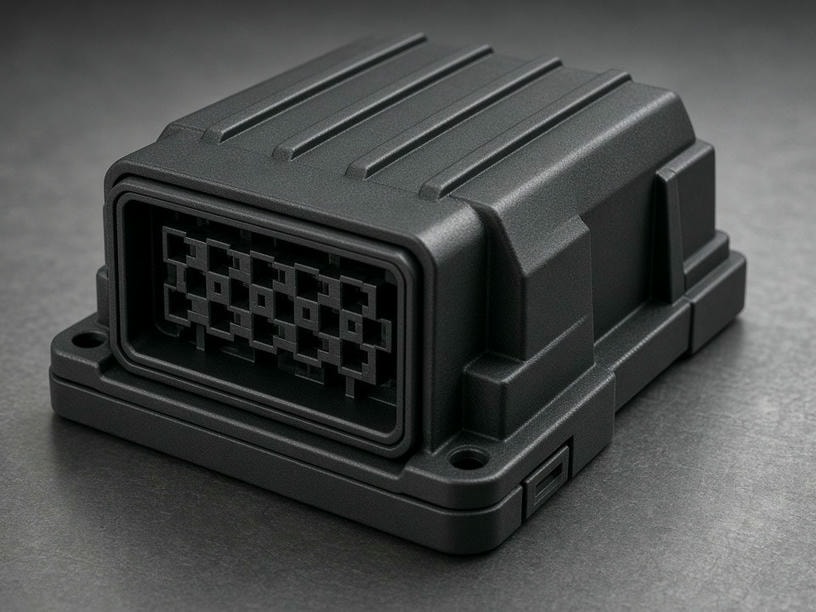
Why PBT
Stable performance for electrical and automotive parts
PBT is a semi-crystalline thermoplastic polyester favored for its rapid crystallization, dimensional stability, and reliable electrical performance. These characteristics support efficient cycle times without compromising part integrity.
Dimensional stability
Low moisture absorption and strong resistance to deformation under load help maintain precise geometry.
Electrical insulation
High dielectric strength makes PBT suitable for connectors, switches, relay housings, and electrical interfaces.
Thermal performance
Glass-filled grades provide high heat deflection temperature for demanding under-the-hood automotive environments.
Chemical resistance
Durability against fuels, oils, and common industrial solvents supports long service life.
Process control
Technical processing parameters for PBT
Precision PBT components depend on controlled moisture, temperature, and mold conditions. Our 50–800 ton injection machinery is operated within defined process windows and adjusted for the selected grade and geometry.
| Parameter | Recommended range or capability |
|---|---|
| Drying temperature | 120°C–140°C, with moisture below 0.02% |
| Melt temperature | 240°C–270°C |
| Mold temperature | 60°C–100°C |
| Mold shrinkage | 0.5%–2.0%, depending on grade and design |
| Heat deflection temperature | Up to 200°C+ for glass-fiber reinforced grades |
| GF grades | Glass-filled PBT selected for stiffness, dimensional control, and thermal performance |
Application expertise
Built for connectors, electrical housings, and automotive parts
We mold complex geometries, thin-wall connectors, and housings that require high-precision inserts. Our engineering team matches gate design, flow behavior, and material grade to the functional requirements of each component.
Thin-wall connector molding
Wall thickness optimization down to 0.5 mm helps reduce material use while preserving structural strength.
Insert molding
Brass and stainless steel threaded inserts can be integrated directly into PBT components.
Mold steel selection
In-house tooling uses P20, 718H, and S136 steels selected for the mold life and application demands.
Material selection
Choose the right PBT grade
Unreinforced PBT
General-purpose electrical components requiring dependable insulation and dimensional control.
Glass-filled PBT
Structural parts requiring superior stiffness, heat resistance, and reduced deformation.
Flame-retardant PBT
Electrical safety applications requiring flame-retardant performance and UL94 V-0 compliance.
Delivery system
From DFM to mass production
PartsMake supports the full product development sequence, helping optimize designs for PBT processing and maintain consistent cycle times at production scale.
Discuss your production plan-
1
DFM analysis
Review draft angles, wall thickness consistency, and gate location to prevent warpage and incomplete filling.
-
2
Tooling design
Develop multi-cavity mold layouts for high-volume efficiency and PBT-specific flow behavior.
-
3
T1 sampling
Validate dimensions, appearance, filling performance, and material behavior during initial trial production.
-
4
Production
Scale from 100 to 1,000,000+ parts with controlled processes and repeatable cycle times.
-
5
Secondary finishing
Complete laser marking, printing, and final assembly of multi-component housings.
Quality assurance
Precision capabilities that protect part consistency
Standard tolerances
Precision molding can reach ±0.03 mm when the design and material allow.
Thin-wall capability
Optimize connector walls for efficient material use and reliable strength.
Surface finishes
Custom textures and SPI finishes support cosmetic electrical hardware requirements.
Insert options
Integrate brass and stainless steel threaded inserts directly into PBT parts.
Technical questions
PBT project guidance
When should I choose glass-filled PBT? +
Glass-filled PBT is typically considered for structural electrical parts and automotive components that need higher stiffness, reduced deformation, and stronger thermal performance.
Can you support flame-retardant electrical housings? +
Yes. Flame-retardant PBT can be evaluated for electrical safety applications requiring UL94 V-0 compliance, subject to the selected material specification and part design.
How do you reduce warpage in complex PBT parts? +
DFM reviews focus on balanced wall thickness, draft, gate location, mold temperature, and fiber orientation. These controls help reduce warpage and incomplete filling in ribbed geometries.
What should I send for a project review? +
Send your CAD files, expected annual volume, application environment, target material grade, and any dimensional or compliance requirements. The engineering team will provide DFM feedback and lead-time guidance.
Start a technical review
Request a quote for your PBT component
Send your CAD files and project specifications to our engineering team. We provide detailed DFM feedback and lead-time estimates for PBT connectors, electrical housings, and automotive parts.
Email:
Address:
Project inquiry
Share your requirements and our team will review the manufacturing path.