Stainless Steel CNC Machining
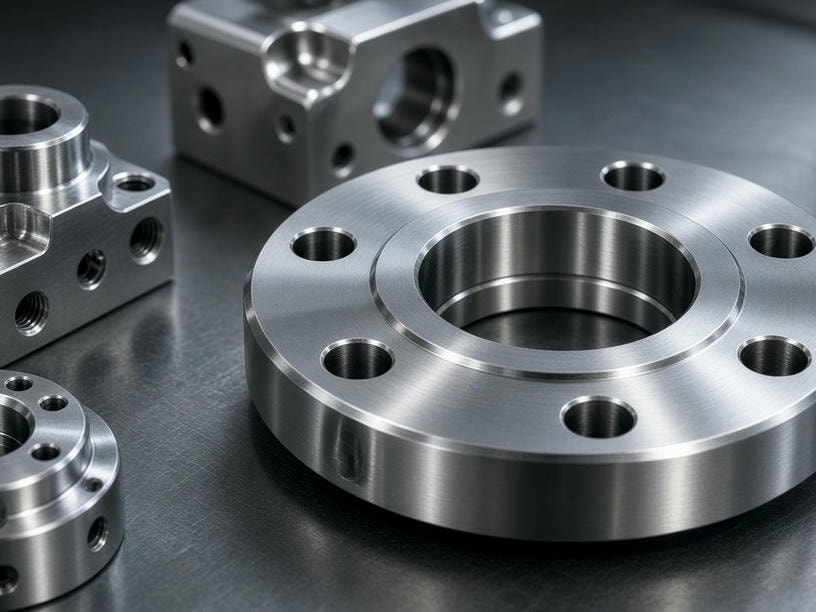
Precision Stainless Steel CNC Machining Services
High-precision stainless steel components for prototypes and production runs from single-piece development to 100,000+ units.
PartsMake supports complex geometries, tight tolerance requirements, and the specific metallurgical demands of 303, 304, 316/316L, 17-4PH, and 15-5PH stainless steel.
±0.005
Precision tolerance mm
Ra 0.4
Surface finish μm
100k+
Production capacity
Material expertise
Select the grade around your part’s actual requirements
The right stainless steel balances strength, hardness, corrosion performance, magnetic behavior, machinability, and heat treatment state—not simply a general corrosion-resistance label.
| Grade | Strength / hardness | Corrosion resistance | Magnetism | Machinability | Typical condition / use |
|---|---|---|---|---|---|
| 303 | Moderate strength; moderate hardness | Moderate | Generally non-magnetic | Excellent | Annealed; complex turned parts and fasteners |
| 304 | Moderate strength; work-hardening alloy | Good general resistance | Generally non-magnetic; may become slightly magnetic after cold work | Moderate | Annealed; food equipment and general hardware |
| 316 / 316L | Moderate strength; 316L supports welded assemblies | Excellent; strong pitting and crevice resistance | Generally non-magnetic | Moderate | Annealed; marine, medical, and chemical processing |
| 17-4PH | Very high strength and hardness after aging | High | Magnetic | Good before heat treatment | H900–H1150 aging states; aerospace and high-stress parts |
| 15-5PH | Very high strength and hardness after aging | High | Magnetic | Good before heat treatment | H900–H1150 aging states; precision valves and turbine parts |
Grade selection insights
Engineering decisions that affect cost and performance
Our team helps align material condition and machining strategy before production begins, reducing avoidable tooling, cycle-time, and post-processing risks.
Manufacturing capabilities
From complex multi-face parts to repeatable production
Our equipment supports simple production components as well as complex, multi-operation stainless steel parts.
CNC Milling
3-, 4-, and 5-axis machining for housings, brackets, and multi-face components.
Turning & Swiss
Precision shafts, pins, and connectors up to Ø32 mm on Swiss-type machines and Ø500 mm on standard turning centers.
Mill-Turn
Combined milling and turning in one setup to maintain concentricity and reduce handling errors.
Precision Grinding
Surface, cylindrical, and centerless grinding for Ra 0.4 μm finishes and accurate mating surfaces.
Standard tolerance
±0.01–0.05 mm
Precision tolerance
Down to ±0.005 mm
Max milling size
1200 × 800 × 600 mm
Max turning size
Ø500 × 1000 mm
Minimum feature
0.5 mm
Quality assurance
Traceable inspection from material lot to finished part
A rigorous quality management process helps ensure each stainless steel component meets your engineering specifications and documentation requirements.
Dimensional control
CMM and optical measurement systems support critical feature verification.
FAI reporting
Full dimensional reports are available for First Article Inspection requirements.
Material traceability
Material certificates and batch traceability are maintained for stainless steel lots.
Metallurgical checks
Hardness testing and surface roughness analysis verify treatment and finish targets.
Start your project
Get a quote for your stainless steel project
Whether you need a functional prototype or full-scale production, PartsMake provides the technical expertise and equipment to deliver to your exact specifications.
Please provide
- 2D/3D CAD files in STEP, IGS, or PDF format.
- Material grade and heat treatment requirements.
- Quantity and delivery expectations.
Email:
Facility: