Custom Injection Mold Tooling Services
PartsMake provides end-to-end injection mold tooling for manufacturers sourcing reliable tooling from China. From DFM and mold design through steel procurement, machining, assembly, and trial production, we manage the complete tool-building lifecycle.
50–800T
Injection machine range
±0.03 mm
Precision tolerance
1M+
Potential mold cycles
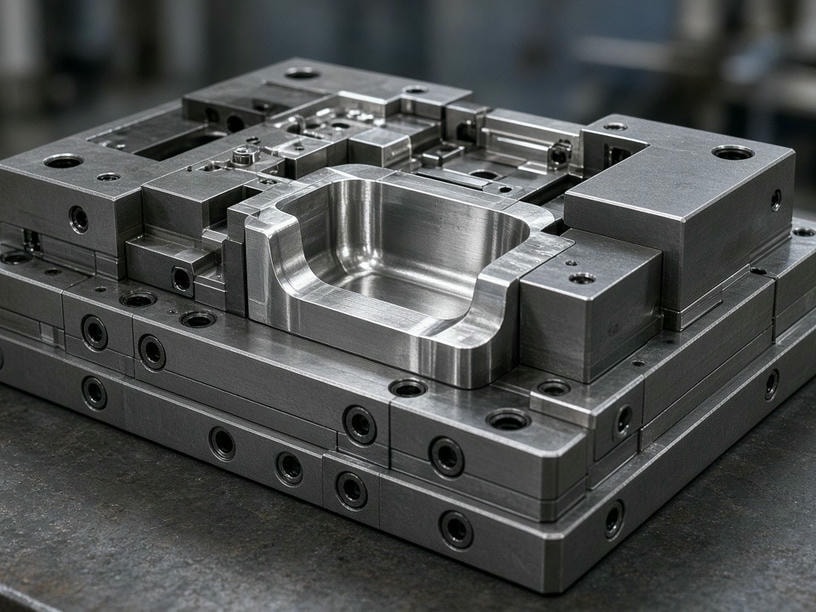
Tool-first engineering
The mold structure, steel, cooling, ejection, and maintenance plan are engineered around your production target.
Tooling scope
Built around the mold, not just the molded part
Our tooling programs support rapid prototype validation, bridge tooling for product launches, and hardened steel production molds for demanding volume requirements.
Typical tooling coverage
- —Single-cavity through multi-cavity molds
- —Prototype, bridge, and production molds
- —Complex sliders, lifters, inserts, and overmolding
- —Thermoplastics from ABS and PP to PEEK and PPS
Technical specifications
Core capabilities for tooling feasibility and supplier comparison.
| Specification | PartsMake Capability |
|---|---|
| Mold Types | Prototype, bridge, and production molds |
| Mold Cavities | Single-cavity to multi-cavity |
| Mold Base Standards | LKM, DME, and equivalent systems |
| Mold Steel Options | P20, 718H, NAK80, S136, H13 |
| Maximum Mold Size | Up to 1000 × 800 mm |
| Injection Machine Size | 50–800 ton |
| Typical Molding Tolerance | ±0.05–0.20 mm |
| Precision Tolerance | Down to ±0.03 mm |
| Mold Life | 10,000 to 1,000,000+ cycles |
Advanced mold engineering
Every critical system is designed before metal is cut
Moldflow analysis helps simulate plastic flow, identify potential air traps, and optimize gate locations before machining begins. The result is a more predictable tool build and a clearer path to T1 approval.
Moldflow analysis
Review filling behavior, air traps, and gate locations to reduce avoidable tooling changes.
Cooling water circuits
Standard or conformal cooling channels support cycle-time control and uniform cooling for dimensional stability.
Ejection systems
Pin, sleeve, and stripper plate mechanisms are matched to part geometry to prevent deformation during release.
Gates and mold actions
Edge, sub-, tunnel, and hot runner gates can be paired with sliders and lifters for complex undercuts.
Steel selection
Choose steel for finish, wear, and production life
We recommend core and cavity steel based on expected volume, surface requirements, material behavior, and the operating environment.
| Steel | Hardness / character | Surface and application fit | Production position |
|---|---|---|---|
| P20 | Pre-hardened, general-purpose tooling steel | Suitable for standard surface requirements and general mold construction | Low to medium production volumes |
| 718H | Pre-hardened with toughness and polishability | Well suited to high-gloss finishes | Higher-duty tooling requirements |
| NAK80 | Pre-hardened with strong dimensional stability | Excellent polishability for precision components | Precision production molds |
| S136 | Corrosion-resistant stainless steel | Medical, optical, and transparent applications requiring surface clarity | Long-life and corrosion-sensitive tooling |
| H13 | Hot-work steel for wear and heat resistance | High-temperature applications and demanding wear conditions | High-volume production tooling |
Tooling process
A controlled path from CAD to T1
Each stage is structured to expose technical risks early and maintain clear documentation through the mold build.
T1 sample reporting
Initial trial samples are supplied with a detailed T1 report, including dimensional inspection data for evaluation and next-step decisions.
-
1
DFM analysis
Review wall thickness, draft angles, ribs, bosses, material behavior, and potential molding issues before design release.
-
2
Mold design
Develop the 3D CAD structure, including cooling, ejection, venting, gates, sliders, and lifters.
-
3
Mold manufacturing
Complete precision CNC machining, EDM, grinding, component fitting, and mold assembly.
-
4
T1 sampling and refinement
Run the initial trial, provide samples and inspection data, then coordinate required adjustments.
-
5
Secondary finishing
Integrate painting, printing, assembly, or other post-molding processes when required.
Production readiness
Tooling that stays accountable after delivery
A production mold requires more than a successful first shot. PartsMake documents the tool and establishes maintenance expectations to protect your investment.
Maintenance records
Documentation covers mold steel certifications, heat treatment reports, inspection data, and preventative maintenance schedules.
Material expertise
Tooling can be engineered for ABS, PP, PE/HDPE, PC, PC/ABS, PA/Nylon, POM, PBT, PET, glass-filled Nylon, PPS, PEEK, PMMA, TPU, and TPE.
Insert molding
Design considerations can include threaded brass inserts and other insert-molding requirements.
Overmolding
Complex overmolding for soft-touch parts is supported with attention to material shrinkage and flow characteristics.
Common questions
Plan your tooling review with confidence
What should be included in a tooling inquiry? +
Please provide 3D CAD files in STEP or IGST format, material specifications, and estimated annual production volume. These details support feasibility review and quotation.
Which mold base standards are supported? +
Tooling can use LKM, DME, and equivalent mold base and standard component systems.
Can the tool support high-volume production? +
Yes. Hardened steel options such as H13 can be considered where high wear resistance and high-volume production are required. Mold life depends on the selected steel, design, material, and operating conditions.
How is the first mold trial documented? +
The T1 trial includes sample parts and a detailed report with dimensional inspection data for evaluation.
Request a tooling quote
Turn your CAD data into a production-ready mold plan
Send your tooling requirements to our engineering department for a feasibility assessment and quotation.
Recommended files: STEP or IGST 3D CAD files
Include: Material specifications and estimated annual production volume
Email:
Address:
Share your tooling requirements
Our engineering team will review your project and respond with the next steps.