Precision electrical discharge machining
Sinker EDM Services for Complex Cavities
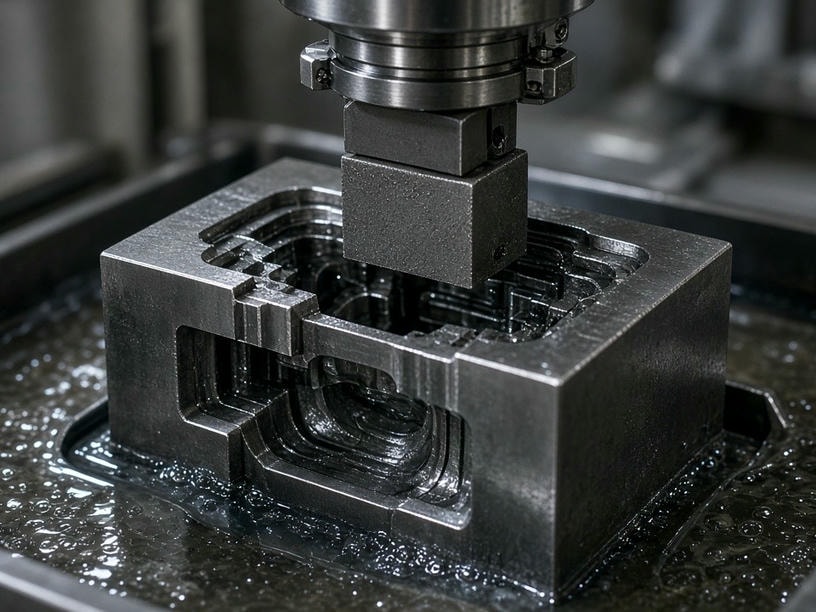
PartsMake specializes in electrode replication for deep cavities, sharp internal corners, hardened tooling, and intricate 3D geometries that traditional cutting tools cannot reach.
±0.005 mm
Dimensional tolerance
Ra 0.2 μm
Surface finish capability
0.05 mm
Minimum internal radius
Built around your CAD data
Electrode design, CNC fabrication, roughing, finishing, and inspection are coordinated to maintain cavity geometry and print requirements.
Why sinker EDM
The right process for geometry conventional tools cannot reach
Sinker EDM creates controlled spark erosion between an electrode and the workpiece. The non-contact process machines hardened tool steels and conductive alloys without mechanical cutting forces or stress.
Because the electrode mirrors the required cavity, it can reproduce sharp internal corners, deep-hole features, and complex 3D forms that a rotating cutting tool cannot physically enter.
Hardened tooling after heat treatment
Machine hardened steel and wear components after heat treatment while reducing the risk of mechanical distortion.
Deep cavities and narrow features
Reach deep internal geometry, channels, and holes where standard drills and milling cutters are limited by access and aspect ratio.
Sharp corners and fine detail
Replicate intricate mold textures, tight internal radii, and complex details through controlled electrode geometry.
Integrated machining route
Combine CNC milling for bulk removal with Sinker EDM for final precision geometry, supported by Wire EDM when appropriate.
Technical envelope
Sinker EDM specifications
Roughing and finishing cycles are planned together to manage electrode wear and keep final dimensions inside the specified tolerance window.
| Feature | Specification |
|---|---|
| Maximum work size | Up to 500 × 400 × 300 mm |
| Dimensional tolerance | Down to ±0.005 mm |
| Surface finish | Down to Ra 0.2 μm |
| Electrode materials | Copper, graphite, or copper-tungsten |
| Minimum internal radius | Down to 0.05 mm, electrode dependent |
| Typical workpiece materials | Hardened steel, tool steel, and conductive alloys |
Electrode strategy
Copper or graphite? We match the electrode to the cavity.
Electrode selection affects surface finish, material removal rate, detail retention, and wear compensation. Our process accounts for overcut during both roughing and finishing passes.
Copper electrodes
Preferred for superior surface finish, including Ra below 0.4 μm, and strong detail retention in small-feature work.
Graphite electrodes
Selected for high material removal rates during roughing and reduced electrode wear, making them cost-effective for large cavity volumes.
Copper-tungsten electrodes
Available when the project requires an electrode material suited to the specified cavity and process conditions.
Applications
Complex cavity work, from mold tooling to wear components
Injection mold cavities
Produce complex runners, gating details, intricate product textures, and deep cavity features through electrode replication.
Deep-hole features
Machine channels and holes where length-to-diameter ratios exceed the practical capability of standard drills.
Hardened wear components
Apply EDM after heat treatment when dimensional stability and resistance to machining-induced warping are important.
Quality control
Verified against the print before shipment
Every component is inspected against its print specifications. Documentation can include First Article Inspection reports, material certifications, and heat-number traceability for critical components.
CMM
700 × 1000 × 600 mm; 2–3 μm accuracy
Optical measuring system
300 × 200 mm; 2–5 μm accuracy
Surface roughness testing
Precise Ra and Rz measurement
Hardness testing
HRC, HRB, and HB industrial standards
RFQ checklist
Give our engineering team the detail needed for an accurate quote
- 013D CAD files: STEP or IGES format.
- 022D technical drawings: PDF with tolerance and Ra callouts.
- 03Material specifications: Include heat treatment requirements.
- 04Quantity: Prototype, pilot, or production run requirements.
Start a technical review
Submit your cavity requirements
Share your technical package and project context for prompt review by the engineering team.
Get a QuoteTechnical questions
Sinker EDM answers for project planning
Request a quote
Turn a difficult cavity into a controlled manufacturing plan.
Send your CAD files, drawings, material details, heat treatment requirements, and quantity for review.
Email:
Address: