Permanent identification for critical components
Precision Laser Marking Services for Custom Components
Create durable, high-contrast serial numbers, logos, QR codes, scales, and traceability marks that remain legible throughout the product lifecycle.
0.01 mm+
Fine line capability
3
Laser technologies
24 hr
Typical quote response
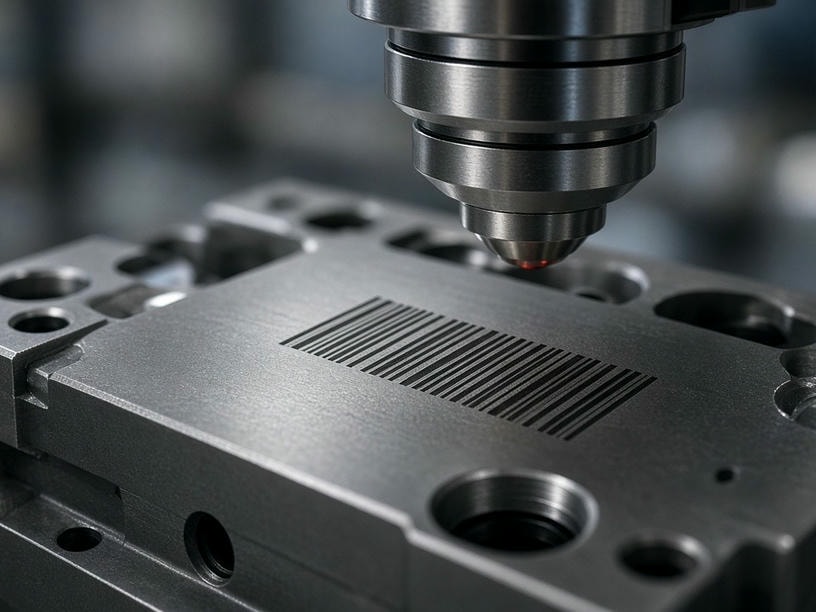
Built for traceability
Mark each part with data that supports scanning, quality control, and lifecycle tracking.
Integrated manufacturing
A permanent mark, applied with production control
Laser marking provides a permanent identification method that resists wear, chemicals, and environmental degradation. Unlike ink-based printing or mechanical stamping, the mark remains legible throughout the product lifecycle.
PartsMake integrates marking into the manufacturing workflow alongside machining or fabrication. This consolidates secondary processes, reduces lead times, and keeps quality control connected from raw material to the finished, labeled part.
Laser technology selection
The right wavelength for your material and mark
Selecting the correct laser type is essential for achieving the required contrast, depth, readability, and structural integrity of the mark.
Fiber Laser
High-speed, high-contrast marking for stainless steel, aluminum, brass, titanium, and other metals.
Deep engraving, annealing, and coating removal
CO2 Laser
Effective, high-speed surface marking for acrylic, wood, plastics, and selected coated materials.
Cosmetic branding and surface labels
UV Laser
A cold marking process that minimizes heat-affected zones on sensitive plastics, glass, medical materials, and micro-electronics.
Fine detail with minimal deformation or burning
Technical specifications
Compare marking performance by laser type
Final results depend on material composition, surface finish, geometry, and required readability. Sample marking is available for material verification.
| Laser type | Suitable materials | Marking depth | Line width | Color effect | Minimum character | Typical application |
|---|---|---|---|---|---|---|
| Fiber | Stainless steel, aluminum, steel, titanium, brass | 0.01–0.5 mm | 0.02 mm+ | High-contrast black, white, or annealed tones | Approx. 1 mm, subject to material and font | Serial numbers, logos, batch codes |
| CO2 | Plastics, acrylic, wood, coated materials | Surface etching | 0.05 mm+ | Material-dependent contrast or tonal change | Approx. 1.5 mm, subject to material | Cosmetic branding, labels |
| UV | Sensitive plastics, glass, medical-grade materials | Surface, with minimal heat | 0.01 mm+ | Fine contrast with low thermal impact | Approx. 0.5 mm, subject to code density | Medical device IDs, micro-QR codes |
Note: Our engineering team can perform sample marking to verify contrast, code readability, depth, and surface compatibility before production.
Traceability systems
Identification that connects the part to its history
Modern manufacturing requires more than a logo. We support structured marking systems that help teams manage inventory, verify quality, and connect physical parts with digital records.
Discuss your traceability requirementsSerial numbers & batch codes
Identify individual units or production runs for inventory management, service, and recall control.
QR codes & Data Matrix
Produce high-density 2D codes designed for reliable scanning and ERP-connected workflows, including ISO 16022 applications.
Scales & graduations
Mark measurement tools, knobs, and dials where alignment, spacing, and line width affect function.
Source-to-assembly traceability
Apply batch-specific data at the source to support tracking from raw material purchase through final assembly.
Engineering verification
Validate the mark before production begins
At PartsMake, laser marking is treated as a critical manufacturing step. Our engineering team reviews your design files, marking content, and part geometry to prevent illegible codes or damaged surfaces.
Surface finish
Assess how bead-blasted, polished, coated, or textured surfaces will affect contrast and scanning.
Material composition
Select the appropriate laser wavelength to avoid material degradation, deformation, or stress concentration.
Readability standards
Review font size, line width, code density, and scanning requirements before the marking program is released.
What to include in your RFQ
Give our engineers the information needed for a reliable mark
- ✓CAD files, drawings, or representative part images
- ✓Material specification and surface finish
- ✓Mark content, location, orientation, and size
- ✓Required code format, scanner, or readability standard
- ✓Prototype quantity or expected production volume
Common questions
Laser marking considerations
Can you mark permanent serial numbers and batch codes? +
Yes. We support permanent, machine-readable serial numbers, batch codes, logos, QR codes, and Data Matrix codes for prototypes and production programs.
How do you improve QR code readability? +
We review module size, quiet zone, code density, contrast, surface finish, and viewing conditions. Sample marking can be used to verify scanning performance before production.
Can laser marking be combined with machining or fabrication? +
Yes. PartsMake can integrate marking into the manufacturing workflow to consolidate secondary operations, reduce handoffs, and maintain quality control through final labeling.
Request a quote
Turn your identification requirements into a production-ready marking plan
From single-piece prototypes to high-volume production, PartsMake provides the technical expertise to mark your components accurately and consistently.
Email:
Office:
Response: Our project management team typically provides a detailed quotation within 24 hours.
Send your laser marking requirements
Share your CAD files, drawings, material details, and marking specifications for an accurate review.