Precision Type II Anodizing Services
Anodizing is more than a cosmetic finish. It is an electrochemical process that thickens the natural oxide layer on aluminum surfaces, improving corrosion resistance, wear protection, and finish consistency.
At PartsMake, we integrate Type II anodizing directly into your manufacturing workflow to reduce secondary-vendor delays and maintain tighter control over dimensional and cosmetic requirements.
5–20 µm
Typical film thickness
4 alloys
Commonly supported
3–5 days
Potential logistics reduction
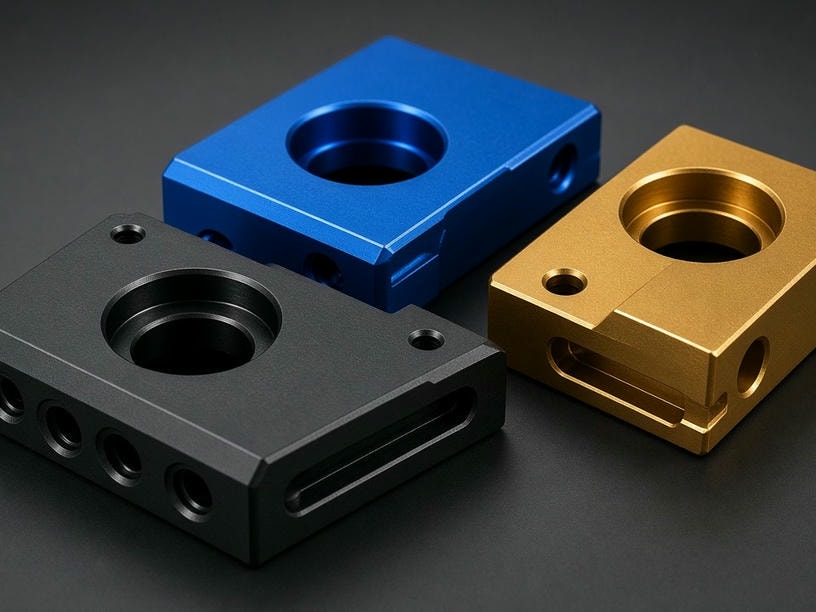
Process focus
Type II anodizing
Application
CNC aluminum parts
Process control
Technical specifications for Type II anodizing
Bath chemistry and immersion time are controlled to help your parts meet strict dimensional, functional, and cosmetic requirements.
| Parameter | Specification / Range |
|---|---|
| Typical Film Thickness | 0.0002" to 0.0008" (5 µm–20 µm) |
| Common Colors | Clear, black, red, blue, gold, and custom dye-match |
| Hardness | Moderate Mohs hardness with improved surface wear resistance |
| Material Compatibility | 6061, 7075, 2024, and 5052 aluminum alloys |
| Dimensional Impact | Growth occurs; typically 50% of film thickness penetrates the part |
| Corrosion Resistance | Excellent; withstands standard salt spray testing |
Alloy behavior
6061 vs. 7075 anodizing results
Aluminum alloy composition directly affects the appearance of an anodized finish. Understanding that difference is important when color consistency matters across a part or assembly.
6061 aluminum
The industry standard for anodizing. It reacts consistently to dyes and provides uniform, saturated colors, making it the primary recommendation for high-end cosmetic finishes.
7075 aluminum
Its higher zinc content can create a slightly duller or cloudier finish than 6061. Process parameters can be adjusted to compensate when matching colors across an assembly.
Cosmetic anodizing control
Approve the intended appearance before full-scale production.
For critical cosmetic parts, color swatches can be provided for approval. Surface preparation, etching, bead blasting, tank chemistry, and temperature are controlled to support batch-to-batch consistency.
Design for finish
Manage tolerances and masking before parts enter the tank
Anodizing adds material to the surface. For precision-machined components with tight tolerances, the expected growth must be considered during CNC programming and manufacturing review.
Dimensional allowance
We calculate expected buildup and adjust CNC toolpaths or post-machining dimensions so the finished part remains within tolerance after coating.
Selective masking
Precision plugs or tape can protect areas that must remain conductive or dimensionally unaltered, including internal threads and grounding surfaces.
Integrated workflow
Why coordinate finishing with PartsMake?
Managing CNC machining and anodizing under one roof reduces handoffs, improves accountability, and helps prevent cosmetic or dimensional issues from being passed between vendors.
Start a manufacturing reviewManufacturing review
Engineers identify trapped volumes or blind holes that could cause chemical bleeding or poor coating adhesion before the first part is machined.
Reduced logistics
Moving from CNC to finishing internally can cut 3–5 days of transit time from the production schedule.
Ready-to-assemble parts
Dimensions are verified after anodizing so parts arrive ready for immediate installation into the final assembly.
Common project questions
Plan the finish with confidence
Use your material, color, tolerance, and masking requirements to start a focused engineering review.
Get your project quote
Send your CAD files and drawing requirements for review.
Our engineering team will assess your material, tolerances, desired color, and surface specifications to provide a production-ready quote.
Facility
Please include your material specifications, desired color, and any critical non-anodized surfaces in your RFQ.
Tell us about your anodizing requirements
Share your drawings, alloy, finish, tolerance, and production requirements with our team.