ENGINEERING MATERIAL GUIDE
Choose the right material before production begins.
Precision parts depend on more than geometry. Align strength, weight, temperature, corrosion, friction, thermal performance, electrical needs, and cost with a manufacturing route built for your application.
7
Manufacturing process routes
4
Lifecycle production stages
DFM
Engineering-led file review
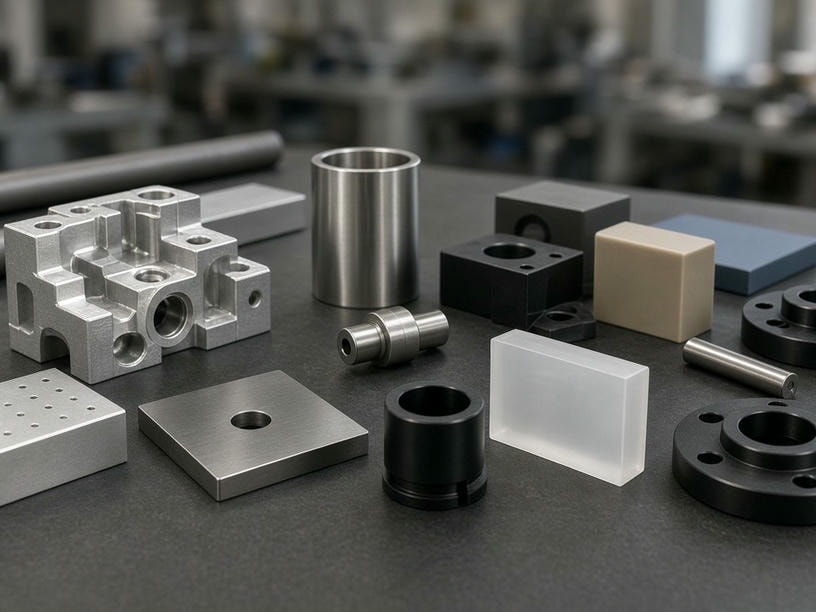
One engineering interface
From CAD review and material selection to inspection and repeat production.
Engineering-first manufacturing
Material decisions connected to production reality.
PartsMake supports engineers, OEMs, and procurement teams worldwide, bridging the gap between initial design and high-quality production.
We review CAD files, tolerances, and intended applications before material is cut. This helps identify manufacturing risks early and keeps parts ready for assembly and field performance.
01
Performance fit
Balance strength, weight, heat, corrosion, friction, and electrical requirements against the real application.
02
Process fit
Match material choice with machining, molding, sheet metal, additive, or EDM requirements.
03
Commercial fit
Consider material cost, lead time, production volume, finishing, and repeatability together.
04
Quality fit
Verify dimensions and material requirements against drawing specifications before shipment.
Core manufacturing capabilities
A production route for complex mechanical requirements.
Coordinate fabrication, finishing, inspection, and assembly through a single manufacturing partner.
| Capability | Range | Typical applications |
|---|---|---|
| CNC Milling | 3, 4 & 5-Axis | Housings, structural components, fixtures |
| CNC Turning | Precision multi-axis | Shafts, bushings, threaded parts |
| Swiss Machining | Up to Ø32 mm | Miniature components, precision pins |
| Injection Molding | Prototype & production | Plastic housings, functional parts |
| Sheet Metal | Cutting, bending, welding | Enclosures, frames, panels |
| 3D Printing | SLA, SLS, MJF, FDM | Rapid prototypes, complex geometries |
| EDM | Wire & sinker | Hardened materials, complex profiles |
Material selection matrix
Compare the main material classes at a glance.
Use this high-level view to narrow the field, then confirm the final grade and process against your drawing, environment, and production requirements.
| Property | Aluminum | Stainless steel | Titanium | Engineering plastics |
|---|---|---|---|---|
| Strength-to-weight | High | Medium | Very high | Low |
| Heat resistance | Moderate | High | Excellent | Low to moderate |
| Corrosion resistance | Good when anodized | Excellent | Excellent | Excellent |
| Machinability | Excellent | Moderate | Difficult | Good |
| Relative cost | Low | Moderate | High | Low to medium |
Strategic selection routes
Start with the performance priority.
These routes provide a practical starting point for engineering discussions. Our team can validate the material, grade, finishing, and process against your application.
Discuss Your ApplicationLight-weighting+
7075-T6 aluminum or carbon-fiber reinforced nylon via 3D printing offer strong strength-to-weight performance for aerospace and robotics.
High-temperature environments+
Grade 5 titanium or Inconel support thermal stability and mechanical integrity in extreme conditions.
Wear and friction+
Hardened 440C stainless steel, PEEK, or Delrin (POM) can provide durability, wear resistance, and self-lubricating performance.
Thermal management+
Oxygen-free copper or 6061 aluminum are established choices for AI hardware, heat sinks, and thermal transfer components.
Cost efficiency+
6061-T6 aluminum for machining or ABS/PC for injection molding balance cost, performance, and high-volume production needs.
From prototype to production
One connected path from first part to repeat order.
PartsMake coordinates multiple processes, including CNC machining, surface finishing, and assembly, to simplify your supply chain.
- 1
Prototype
Rapid iteration using 3D printing or soft-tooling.
- 2
Engineering samples
Validate design intent with production-grade materials.
- 3
Pilot production
Fine-tune processes for volume efficiency.
- 4
Repeat production
Maintain consistent, quality-controlled manufacturing with inspection reporting.
Quality and inspection
Verification built into the delivery process.
Quality is not an afterthought. Dimensional and material verification are performed against your specific drawing requirements.
- ✓Dimensional checks for critical features and tolerances
- ✓Material verification aligned with project requirements
- ✓Support for tight geometric tolerances and cosmetic finishes
- ✓Compliance review before parts leave the facility
Partner with PartsMake
Ready to make a confident material decision?
Stop managing multiple vendors for a single assembly. Share your CAD files and technical requirements for an engineering-led DFM review and material compatibility discussion.
Technical inquiry
Send your CAD files and requirements to the engineering team.
Email:
Headquarters: