High-volume metal forming and tooling
Precision Sheet Metal Stamping Services for High-Volume Production
Transition from prototype manufacturing to reliable mass production with stamping solutions engineered around tooling investment, cycle time, material utilization, and total unit cost.
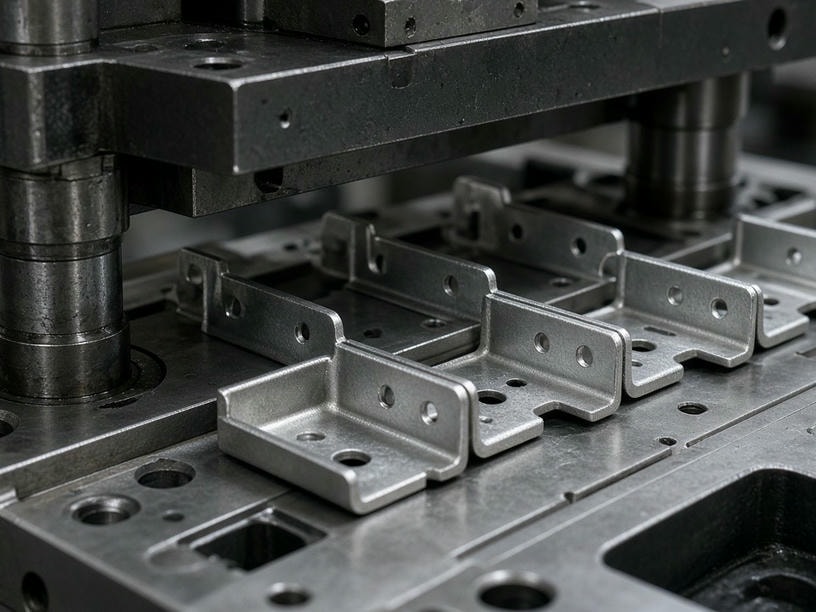
PartsMake combines die design expertise and press capacity to produce consistent components at scale, helping procurement and engineering teams identify the point where stamping becomes more economical than laser cutting and manual forming.
25T–400T
Press tonnage
5,000+
Recommended volume
Cost strategy
Balance tooling investment with lower unit cost
The primary advantage of stamping is speed and repeatability with minimal material waste. The tradeoff is the upfront investment in custom dies, which must be justified by the expected production volume.
Our team helps procurement and engineering stakeholders calculate the crossover point: the production quantity at which the reduced unit cost of stamped parts offsets the cost of tooling. For projects requiring 5,000 or more pieces, stamping can remove secondary labor associated with manual bending or drilling and reduce total cost of ownership over the product lifecycle.
5,000+
Typical volume where stamping economics become compelling
Lower
Per-part cost at production scale
Stable
Repeatability from hard-tooled processes
Production range
Technical capabilities and press specifications
Our mechanical and hydraulic press capabilities cover simple blanking through complex deep-drawn and multi-feature components.
| Specification | PartsMake Capability |
|---|---|
| Press Tonnage | 25T to 400T |
| Material Thickness | 0.3 mm–6.0 mm |
| Maximum Feeding Width | Up to 800 mm |
| Typical Tolerance | ±0.05 mm–±0.15 mm |
| Tooling Types | Single-stage, compound, progressive dies |
| Recommended Volume | 5,000–500,000+ pieces |
| Common Materials | SPCC, stainless steel 304/316, aluminum, copper, brass |
Tooling selection
Select the right stamping die
Die selection depends on geometry, feature accuracy, number of operations, and annual volume. Compare the options before committing to tooling.
Discuss your die strategyBest for low-to-medium volumes
Single-stage dies
A practical choice for simple parts or projects where one operation, such as blanking or punching, is completed per press stroke.
Best for multiple operations
Compound dies
Punching and blanking happen in a single press stroke, improving positional accuracy between features while reducing handling.
Best for high-volume production
Progressive dies
Strip stock moves through multiple stations that perform forming, piercing, trimming, and other operations automatically for maximum output.
Feature forming
Build functional features into the part
Stamping can do more than produce a flat blank. The right sequence of operations adds strength, mounting functionality, and repeatable three-dimensional geometry.
01
Punching and piercing
Create precise holes, slots, and complex cutouts for assembly and fastening.
02
Deep drawing
Form cups, shells, and enclosures from flat sheet metal with controlled material flow.
03
Flanging
Strengthen edges and create consistent mounting surfaces for downstream assembly.
04
Embossing and ribbing
Add stiffening features to thin-gauge materials and help prevent deformation.
Process decision
When does stamping beat laser cutting?
Laser cutting and CNC bending remain valuable for prototypes and low-volume programs. Consider a stamping transition when production requirements make recurring labor and material loss more expensive than dedicated tooling.
Labor costs are rising
Automated forming reduces repeated setup and manual bending work on every part.
Consistency is critical
Hard-tooled processes produce highly repeatable features and reduce extensive post-production inspection.
Material utilization matters
Progressive stamping can tightly nest parts on coil stock and reduce scrap compared with individual sheet processing.
Engineering review
Submit your project for a feasibility review
Share your CAD files, drawings, material requirements, and expected annual volume. Our engineering team will review the design before tooling is manufactured and identify opportunities to simplify the die, improve manufacturability, and lower your final piece price.
Email:
Facility: PartsMake Manufacturing Facility
Address: