Polypropylene (PP) Machining and Custom Fabrication Services
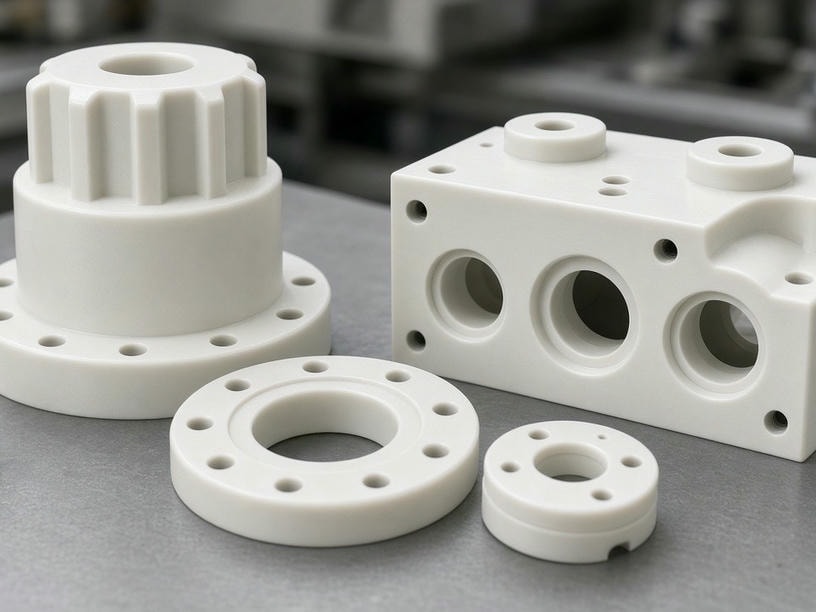
PartsMake provides precision CNC machining and custom fabrication services for Polypropylene. From engineering-grade prototypes to low-volume production, we help product teams use PP's low density, chemical resistance, and high fatigue resistance with confidence.
0.90–0.91
g/cm³ typical density
±0.01–0.05
mm standard tolerance
0.5 mm
minimum machined wall
Built for
Prototypes to low-volume production
Special focus
Living hinges and fluid handling
Material selection
Select the PP grade around the part's real job
Homopolymer and copolymer grades offer different balances of stiffness, impact resistance, and fatigue performance. The right choice depends on load, temperature, hinge movement, and the expected environment.
Engineering review includes
- ●Load and dimensional stability requirements
- ●Impact and low-temperature exposure
- ●Fatigue life for hinges and snap-fits
Stiffness and load support
PP Homopolymer
PP homopolymer offers higher stiffness and tensile strength, making it suitable for structural applications, laboratory equipment, and components requiring dimensional stability under load.
Best fit
Housings, brackets, lab components
Primary benefit
Higher stiffness under load
Technical reference
Typical Polypropylene properties
Standard PP grades processed at PartsMake combine low density with practical strength, chemical resistance, and useful thermal performance.
PP shrinkage is especially important when transitioning from prototype to production tooling. Our engineering team reviews 3D models to help keep tolerances within specification.
Design for performance
Build reliable living hinges and thin-wall parts
Polypropylene is uniquely suited to living hinges because of its high flexural fatigue life. Careful geometry and manufacturing decisions are essential for repeated bending without stress whitening or premature failure.
Hinge geometry
Make the hinge thin enough for repeated bending while retaining adequate structural integrity.
Flow path and orientation
For injection-molded or filled grades, account for fiber orientation and flow direction to reduce hinge failure risk.
Wall thickness and rigidity
Machining to 0.5 mm is possible, but ribs or gussets may be needed to control warping in large, thin-walled covers and enclosures.
Manufacturing capabilities
Accurate PP parts without unnecessary complexity
CNC milling
3-axis and 5-axis capabilities for complex geometries, housings, and medical device components.
Precision turning
Suitable for cylindrical parts, bushings, fluid connectors, and related components.
Dimensional control
Standard machining tolerances of ±0.01–0.05 mm, with compensation for expansion and tool pressure.
Surface finishing
Natural, matte, or polished finishes based on cosmetic and functional requirements.
Application fit
Where PP delivers practical value
Use PP when low weight, chemical resistance, fatigue life, and cost efficiency matter across the product lifecycle.
01
Medical packaging
Sterile containers, trays, and housing components requiring high chemical resistance.
02
Fluid handling
Valves, fittings, and tanks designed to resist acids and bases.
03
Consumer goods
Living-hinge closures, snap-fit components, and durable lightweight enclosures.
04
Industrial components
Brackets, separators, and lightweight structural parts for demanding environments.
Quality assurance
Proof at every inspection stage
Every batch of Polypropylene parts is checked against your specifications, from raw material traceability to final visual condition.
CMM inspection
Verification of complex geometries and hole positions.
Dimensional reporting
Full dimensional reports available for First Article Inspection.
Material certification
Traceability maintained for all raw material lots.
Visual inspection
Strict checks for burrs, stress marks, and finish requirements.
Start your PP project
Move from design review to production with confidence
Whether you have a finished design or need guidance on material selection and manufacturability, PartsMake supports your project from prototype through full-scale production.
Request a technical assessment
Submit your CAD files for a prompt review of material choice, tolerances, living hinges, and manufacturability.